
Once a pile is poured, nobody sees it again, and a badly built pile cannot be reached or repaired. That is why pile foundation reinforcement in Mumbai deserves far more attention than it usually gets. If the steel is wrong, the pile is weaker than the design assumes, and the problem stays hidden until it is too late to fix. In this guide, Vijay Infra, a trusted provider of pile foundation services in Mumbai, explains what a reinforcement cage is, what separates a sound one from a risky one, and which checks to complete before any concrete is poured.
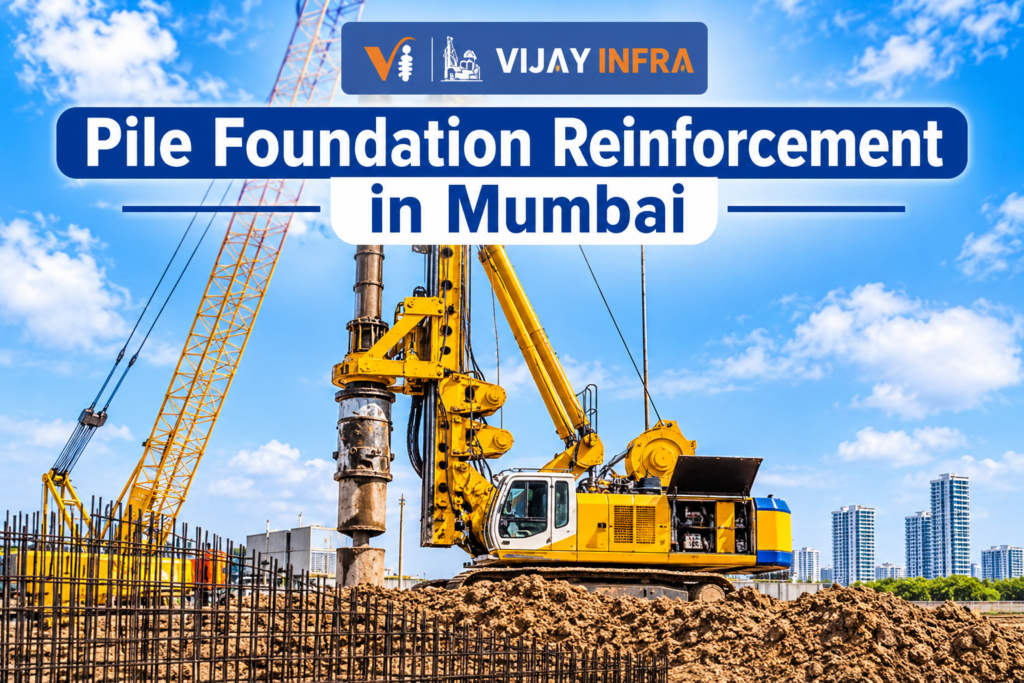
What Is a Pile Reinforcement Cage in Pile Foundation Reinforcement?
A reinforcement cage is a cylindrical frame of steel bars, built to the structural engineer’s drawings and lowered into the bored hole before concreting. It is made up of these components:
- Main (longitudinal) bars: Vertical bars that resist bending and tension. They run the full length of the pile, and their number, diameter and grade are fixed by the structural design.
- Lateral ties or spiral reinforcement: Hoops or a continuous spiral wrapped around the main bars. They hold the bars in position, confine the concrete and resist shear.
- Stiffener rings: Heavier internal rings, spaced along the cage, that stop it from deforming while it is lifted and lowered.
- Spacers: Plastic or concrete blocks fixed around the cage. They keep it centred in the bore and maintain concrete cover on all sides.
A good cage holds its shape, stays centred, remains clean and lets concrete flow freely around and through it.
Why Reinforcement Matters More in Mumbai
Piles in Mumbai and the surrounding region work in demanding conditions, and several of them put extra pressure on the steel.
Coastal and reclaimed ground. Much of Mumbai, Navi Mumbai and the Vasai–Virar belt sits on soft clay, reclaimed land or areas with a high water table. Salt-laden groundwater speeds up corrosion if the steel is not protected by enough concrete cover.
Heavy structural loads. High-rise towers, commercial complexes and industrial buildings put large vertical loads on piles, and wind and seismic forces add lateral loads. These are exactly the loads the reinforcement is there to resist.
Tight urban plots. Redevelopment sites often sit beside occupied buildings, leaving little room to correct mistakes. Piles have to be right the first time.
Monsoon conditions. Heavy rain affects bore stability, groundwater levels and the condition of the steel stored on site. Wet, muddy conditions make cage handling harder.
Our article on how Vijay Infra builds stable foundations in Mumbai covers monsoon, marine clay and heavy loads in more detail.
Why Pile Foundation Reinforcement in Mumbai Matters Even with “Strong” Concrete
It is tempting to assume that high-strength concrete alone makes a pile safe. It does not. Concrete is strong in compression but weak in tension. A pile is more than a column under a straight downward load. It can bend when the soil around it shifts, when loads act off-centre, or when wind and earthquake forces hit the structure above.
Steel fills that gap. It carries the tension that concrete cannot, holds the pile together if the concrete cracks, and lets the pile deform without sudden failure. That is why pile foundation reinforcement in Mumbai can never be treated as a routine step. Even a perfect concrete mix cannot make up for a poorly built cage.
Seven Things That Decide Pile Foundation Reinforcement in Mumbai
1. Correct Bar Size, Grade and Spacing
The design drawings and bar bending schedule specify the bar diameter, steel grade, number of bars and tie spacing. Good pile foundation reinforcement in Mumbai starts by checking these before fabrication, not after the cage is built. Using a lower grade, a thinner bar or fewer bars directly reduces the pile’s capacity, even if the cage looks fine from the outside.
2. Steel Quality and Condition
Steel should arrive with proper test certificates, and what reaches the site should match them. Bars must be free of heavy rust, oil, mud and loose scale, because these weaken the bond between steel and concrete. Light surface rust is generally acceptable, but flaking rust should be cleaned off. For pile foundation reinforcement in Mumbai, monsoon storage matters as well, since steel left on wet ground deteriorates quickly. It should be stacked off the ground and covered.
3. Adequate Concrete Cover
Cover is the distance between the steel and the soil face of the pile. If there is too little, groundwater and salts reach the steel, which corrodes and expands, cracking the concrete from inside. The required cover depends on the design specification and exposure conditions. On coastal sites, cover is one of the biggest durability factors in pile foundation reinforcement in Mumbai.
Spacers must be fixed at regular intervals around the cage and along its full length, so cover stays uniform instead of disappearing on one side.
4. Enough Gap for Concrete to Flow
If bars are packed too tightly, concrete cannot pass through the cage properly, and voids or honeycombing can form. Bar spacing must leave room for the tremie pipe and for concrete to flow around the steel. This matters most in deep bored piles, where concrete is placed under water or bentonite slurry and cannot be vibrated like concrete in a column or slab.
5. Strong Joints and Secure Tying
Long piles need cages made in sections, which are joined above the bore as they are lowered. Lap lengths must follow the design, and bars must be tied or welded as the engineer specifies. Poorly tied joints can shift or slip during lifting and leave steel out of position. Joints are among the first places to inspect, and a careful check here is a mark of quality pile foundation reinforcement in Mumbai.
6. Safe Lifting and Accurate Placement
A cage that bends or twists during lowering will sit off-centre in the bore, reducing cover on one side. Stiffener rings and properly located lifting points prevent this. The crane operator and the site team need to coordinate so the cage is lowered smoothly without being dropped, scraped against the bore wall or forced into place.
7. Holding the Cage in Position During Concreting
As concrete is poured, it can push the cage upward or sideways. The cage needs to be secured at the correct level, usually by hanging it from the casing or a support frame, so that it stays at the designed position until the concrete has been placed.
Common Pile Foundation Reinforcement Mistakes on Piling Sites
Most problems with pile foundation reinforcement in Mumbai come from a small set of repeated errors:
- Building cages to the wrong drawing or an outdated revision
- Using too few spacers, or none, so cover varies or disappears
- Allowing rusted, oily or muddy steel to go into the bore
- Leaving a cage standing in the bore for too long before concreting
- Failing to recheck bars that have bent during lifting
- Not securing the cage, so it rises during the pour
- Making the bar spacing too tight for concrete to flow
- Skipping inspection because the schedule is under pressure
Each of these is preventable with a simple check at the right time. The costly part is that most of them cannot be fixed once the pile has been concreted.
Pile Foundation Reinforcement Checklist Before Concreting
Before a cage is lowered and the pour begins, we recommend confirming the following. This checklist is the quickest way to keep pile foundation reinforcement in Mumbai on track:
- Bar diameter, grade and count match the latest approved drawing.
- Tie or spiral spacing is as specified.
- Lap lengths, joints and ties are correct and secure.
- Spacers are fixed at the planned intervals and all around the cage.
- The cage is clean, straight and free of loose rust, oil or mud.
- Cage length and top level match the pile design.
- The bore depth has been verified and the base cleaned.
- Lifting equipment and support arrangements are ready.
- Concrete supply is confirmed so the pile can be completed in one continuous operation.
This step sits within the wider process Vijay Infra follows on every project, which runs from site inspection and soil investigation through customised planning, execution and final quality checks. You can read more on our About Us page.
Pile Foundation Reinforcement Across Different Pile Types
The cage design and the way it is handled change with the piling method. Each method needs its own approach to pile foundation reinforcement in Mumbai, as shown below.
Bored piles. The cage is lowered into a drilled hole. Bored piles suit urban sites where vibration must be kept to a minimum, and the cage must be placed accurately because there is little room for error near existing buildings.
Rotary piles. Used for high-load infrastructure and high-rise projects, rotary piles often need long, heavy cages. Careful lifting, stiffening and joint control become even more important at these sizes.
Cast-in-situ piles. Because concrete and steel are placed directly on site, cage positioning and concrete cover are critical to the pile’s long-term durability.
Liner and casing piles. In loose or collapsing soil, the casing supports the bore while the cage is placed and concrete is poured. The cage must be lowered carefully so it does not catch on the casing, and the casing must be withdrawn in a controlled way so the cage stays in position.
Micropiles. These smaller-diameter piles are used on restricted-access sites and for underpinning old buildings. They typically use a central high-strength steel bar or a small cage instead of a large one, and grout bonds the steel to the ground.
You can see the full range of methods, and how each one supports pile foundation reinforcement in Mumbai, on our services page.
How Reinforcement Affects Project Timelines and Cost
Reinforcement work looks like a routine step, but it affects both schedule and budget. A cage that fails inspection has to be lifted out, corrected and reinstalled, which costs rig time, labour and crane hours. If a problem is found only after the concrete has set, the cost rises sharply, because the pile may need testing, remedial work or even replacement.
Getting the reinforcement right the first time is one of the simplest ways to protect your timeline. Our article on the pile foundation timeline in Mumbai explains how each stage fits together, and our guide to pile foundations for redevelopment projects shows why these checks matter even more when you are working next to occupied buildings.
What Developers and Builders Should Ask Their Piling Contractor
If you are comparing contractors, these questions reveal how seriously a company takes reinforcement:
- Who checks the cage against the drawing before it is lowered?
- How are cover and spacers controlled?
- How are cages handled and stored during the monsoon?
- What happens if a cage fails inspection?
- Are inspection records kept for each pile?
- How are joints and lap lengths verified in long cages?
A contractor who answers these clearly and in detail is usually one who treats the unseen parts of the job with the same care as the visible ones.
Frequently Asked Questions
What is a reinforcement cage in a pile foundation?
It is a cylindrical frame of steel bars and ties lowered into the bored hole before concreting. It gives the pile strength against bending, tension, shear and lateral loads.
Why is concrete cover important for piles?
Cover protects steel from groundwater and salts. Without enough of it, the steel corrodes and the pile’s strength and service life are reduced, which is a real concern in coastal parts of Mumbai.
Can a poorly placed cage be fixed after concreting?
No. Once the concrete is placed, the cage cannot be corrected. That is why every check must be completed before the pour begins.
Do all piles use the same reinforcement?
No. Reinforcement depends on the structural design, soil conditions, loads and pile type. The structural engineer’s drawings always decide the details.
How are steel cages kept in position during concreting?
They are secured at the correct level using support arrangements, and spacers keep them centred in the bore so that rising concrete does not shift them.
Does Vijay Infra offer a site consultation?
Yes. You can request a free consultation through our contact page.
Planning a Piling Project in Mumbai?
Strong piles come from getting details right that nobody sees once the pour is done. Vijay Infra brings 22+ years of experience in pile foundation work across Mumbai, Navi Mumbai, Thane, Panvel, Kalyan, Dombivli, Vasai, Virar and Bhayandar, covering residential, commercial, industrial and infrastructure projects.
Conclusion
A pile is only as strong as its hidden steel cage. Correct bar size, adequate cover and secure joints decide whether a pile lasts for decades, and they are the heart of good pile foundation reinforcement in Mumbai. Simple checks before concreting, backed by a reliable pile foundation company in Mumbai, protect your budget, timeline and the safety of the structure.