
Pile Foundation for Residential Buildings in Mumbai
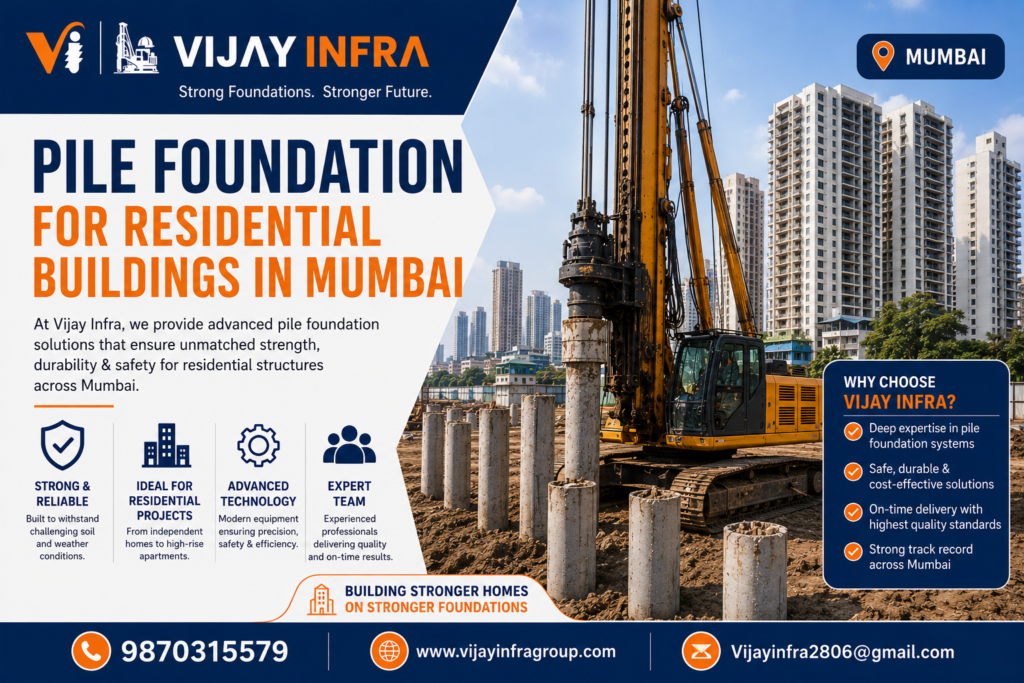
Building a home in Mumbai is a dream for millions. But beneath every strong home lies an even stronger foundation. When it comes to high-rise and multi-storey residential construction in one of India’s most densely populated cities, choosing the right foundation system is not optional — it is critical. Pile Foundation for Residential Buildings is the most reliable and widely used deep foundation technique in Mumbai’s challenging soil conditions. Whether you are constructing a bungalow, apartment complex, or society building, understanding how pile foundations work can save you from long-term structural failures and costly repairs. Leading experts like Vijay Infra have been delivering trusted Pile Foundation Services in Mumbai for residential projects across the city, helping builders and homeowners build safely from the ground up. In this blog, we explore everything you need to know about Pile Foundation for Residential Buildings in Mumbai — from types and benefits to quality standards and common defects. Step 1: Understanding Pile Foundation for Residential Buildings A pile foundation is a type of deep foundation where long, slender structural members are driven or cast deep into the ground to transfer the load of a structure to a stronger soil layer or rock beneath. In Mumbai, due to soft alluvial soil, reclaimed land, and high water table zones, Pile Foundation for Residential Buildings is the preferred method over shallow foundations like strip or raft foundations. Piles work either by skin friction or by end bearing. In most Mumbai residential projects, reinforced concrete bored piles are used as they offer excellent load-bearing capacity and are suitable for urban construction sites with limited space. Step 2: Why Mumbai’s Soil Makes Pile Foundation Essential Mumbai is built on a complex geological profile that includes coastal areas, reclaimed land near the sea, and zones with black cotton soil — all highly problematic for shallow foundations. Key soil challenges include soft marine clay with poor bearing capacity, a high groundwater table in low-lying zones, expansive black cotton soil that swells and contracts with moisture, and loose filled deposits near Bandra, Kurla, and Andheri. In such conditions, Pile Foundation for Residential Buildings bypasses weak upper layers and transfers structural loads safely to firm strata below — making it not just preferable but absolutely necessary. Step 3: Types of Pile Foundation for Residential Buildings For Pile Foundation for Residential Buildings in Mumbai, the following types are commonly used: Bored Cast-In-Situ Piles — Most widely used. A borehole is drilled, a reinforcement cage is placed, and concrete is poured in-situ. Driven Precast Piles — Precast concrete piles driven into the ground using a hammer. Suitable where soil displacement is acceptable. Micro Piles — Smaller diameter piles for confined spaces or underpinning existing structures. Franki Piles — A driven pile with an enlarged base for increased end-bearing resistance in deep hard strata. A structural engineer evaluates the soil investigation report to recommend the most suitable pile type for each residential project site. Step 4: Step-by-Step Process of Pile Foundation Construction The construction of Pile Foundation for Residential Buildings in Mumbai follows this systematic process: Soil Investigation — Bore logs and Standard Penetration Tests (SPT) identify the bearing layer depth. Pile Layout Design — A licensed engineer designs pile spacing, diameter, and depth based on load distribution. Equipment Mobilization — Hydraulic rigs, casing pipes, and CFA machines are brought to site. Boring / Driving — Holes are bored or piles driven to the designed depth to reach bearing strata. Reinforcement Cage Placement — A fabricated steel cage is lowered into the borehole before concreting. Concreting — M25 or higher grade concrete is poured through a tremie pipe under controlled conditions. Pile Testing — Static or dynamic load tests verify pile performance. Pile Cap Construction — Pile caps and grade beams tie piles together into a unified foundation system. This process ensures every Pile Foundation for Residential Buildings project meets structural and safety standards required by MCGM. Step 5: Pile Foundation Quality Control Maintaining strict pile foundation quality control throughout every stage is one of the most critical aspects of successful construction. Poor quality control leads to structural failure, expensive rectification, or even building collapse. Key pile foundation quality control measures include verifying soil data before finalizing design, using calibrated equipment, maintaining proper concrete mix design with M25 minimum grade, ensuring correct reinforcement cover, continuous supervision during concreting to avoid cold joints or voids, maintaining pile installation records, and conducting Pile Integrity Tests (PIT) and Initial Load Tests (ILT) as per IS 2911. Pile foundation quality control is a continuous process from soil investigation to load testing — any compromise can lead to serious structural consequences. Step 6: Common Pile Foundation Defects to Watch Out For Even with careful planning, pile foundation defects can occur if proper supervision is not maintained. Common pile foundation defects include: Necking — Reduction in pile cross-section due to soil pressure during concreting in soft ground. Honeycombing — Air voids in concrete from improper vibration or segregation. Pile Head Damage — Damage at the pile top during driving or improper cut-off management. Misalignment — Piles deviating from planned location or verticality, affecting load distribution. Short Piling — Piles not reaching the designed bearing stratum due to incorrect soil data. Contaminated Concrete — Concrete mixed with soil or water ingress during placement. Regular pile integrity testing and adherence to IS 2911 guidelines are the best defenses against pile foundation defects in Mumbai residential projects. Step 7: Causes of Pile Failure in Residential Buildings Understanding the causes of pile failure is essential to prevent catastrophic structural damage. Top causes of pile failure include inadequate soil investigation leading to incorrect pile design, design errors such as ignoring negative skin friction, poor concreting practices using sub-standard materials, inadequate reinforcement with lower yield strength steel, construction defects like improper boring technique or premature casing withdrawal, and post-construction factors such as nearby excavation, groundwater table changes, or seismic activity. Addressing the causes of pile failure requires both proactive design and reactive real-time monitoring during construction. Step
Common Problems in Piling Work and How to Avoid Them
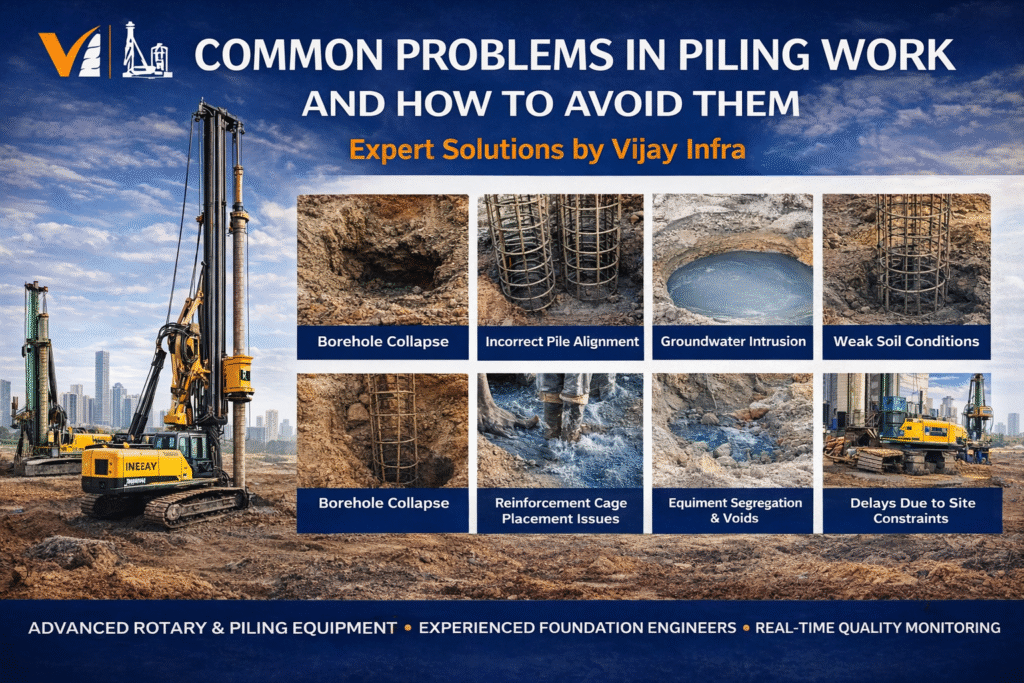
Piling work forms the backbone of every major construction project, providing the deep foundation support that high-rise buildings, bridges, and industrial structures need to stand strong for decades. However, Common Problems in Piling Work can compromise structural integrity, delay project timelines, and increase overall construction costs if not addressed properly. Understanding these challenges and their solutions is essential for engineers, contractors, and property developers alike, especially those relying on professional Pile Foundation Services in Mumbai to execute large-scale projects safely. In this detailed guide, we will walk you through the most frequent Common Problems in Piling Work encountered on construction sites and the proven methods to prevent them. Whether you are managing a residential project or a large-scale commercial development, this step-by-step breakdown will help you make informed decisions about foundation work. Why Piling Work Quality Matters Before diving into specific problems, it’s important to understand why precision in piling work is non-negotiable. Piles transfer structural loads from the building down to stable soil or rock layers below the surface. Any defect in this process can lead to uneven settlement, cracks, or even structural failure over time. This is why working with an experienced Pile Foundation Company in Mumbai is critical for ensuring long-term safety and durability, and why choosing the right Pile Foundation Services in Mumbai matters from day one. Step 1: Identifying Common Pile Foundation Defects Most Common Problems in Piling Work trace back to a set of recognizable pile foundation defects that appear during or shortly after construction. Identifying these early is the first step toward a stable, long-lasting structure. Common defects include: Surface cracking or spalling on the pile shaft Honeycombing or voids within the concrete Inconsistent pile diameter along its length Exposed or improperly placed reinforcement Visible discoloration indicating water intrusion How to Avoid It: Routine inspection during and after casting, combined with integrity testing methods such as low-strain pile integrity tests, helps detect pile foundation defects before they escalate. Engaging a qualified Pile Foundation Company in Mumbai for inspection at each stage ensures defects are caught while they are still easy and inexpensive to correct. Step 2: Understanding the Causes of Pile Failure Once defects are identified, it’s equally important to understand the underlying causes of pile failure so the same mistakes aren’t repeated on future projects. Pile failure rarely happens due to a single factor; it’s usually the result of multiple compounding issues. Major causes of pile failure include: Poor or incomplete soil investigation before design Substandard construction materials or workmanship Incorrect pile design for the actual site conditions Environmental factors such as heavy rainfall or flooding Overloading beyond the pile’s designed capacity How to Avoid It: A detailed geotechnical study, paired with realistic load calculations and a qualified design review, addresses most of the causes of pile failure before construction even begins. Working with experienced providers of Pile Foundation Services in Mumbai who understand local soil behavior significantly lowers this risk, since site-specific knowledge often makes the difference between a stable pile and a failed one. Step 3: Implementing Pile Foundation Quality Control The final and most important safeguard against Common Problems in Piling Work is consistent pile foundation quality control throughout every phase of the project, from design to final inspection. Effective quality control measures include: Pre-construction soil and material testing Continuous on-site supervision during installation Static and dynamic load testing after pile completion Documentation and verification of every construction stage Third-party audits for large or high-risk projects How to Avoid It: Establishing a strict pile foundation quality control checklist, and assigning trained engineers to oversee compliance at every stage, ensures that defects and failures are caught before they become structural risks. A reputable Pile Foundation Company in Mumbai will typically have these protocols built into their standard project workflow rather than treating them as optional add-ons. Why Choose Professional Piling Contractors Given the complexity of these issues, it becomes clear that piling work requires specialized expertise, advanced machinery, and rigorous pile foundation quality control at every stage to avoid the Common Problems in Piling Work discussed above. This is where Vijay Infra steps in as a trusted name in the foundation industry. With years of hands-on experience handling diverse soil conditions and project scales, the team focuses on precision engineering and strict adherence to safety standards while delivering reliable Pile Foundation Services in Mumbai. If you’re searching for a dependable Pile Foundation Company in Mumbai, working with specialists who understand local soil behavior and regulatory requirements can save you significant time, money, and structural risk in the long run. Choosing the right Pile Foundation Company in Mumbai also means fewer surprises once construction is underway. Frequently Asked Questions (FAQs) Q1. What are the most Common Problems in Piling Work? The most frequent Common Problems in Piling Work include pile foundation defects such as cracking and honeycombing, underlying causes of pile failure like poor soil investigation, and lapses in pile foundation quality control during construction. Q2. What are the most common pile foundation defects? Common pile foundation defects include surface cracking, voids or honeycombing in the concrete, inconsistent pile diameter, and exposed reinforcement, all of which can compromise structural performance if left unaddressed. Q3. Does soil type affect piling problems? Yes, soil type plays a major role. Clayey, saturated, or loose soils are significant contributors to several causes of pile failure and are often listed among the Common Problems in Piling Work. Q4. What are the leading causes of pile failure? The leading causes of pile failure include incomplete soil investigation, substandard materials, incorrect design assumptions, environmental factors, and loads that exceed the pile’s designed capacity. Q5. How does poor workmanship lead to pile failure? Poor workmanship during installation, such as inconsistent concrete placement or inadequate supervision, is one of the most preventable causes of pile failure and a key reason quality control matters. Q6. Can pile foundation defects be fixed after construction? Some minor pile foundation defects can be repaired, but severe issues like deep cracking or honeycombing often
Best Pile Foundation Methods for Different Soil Types
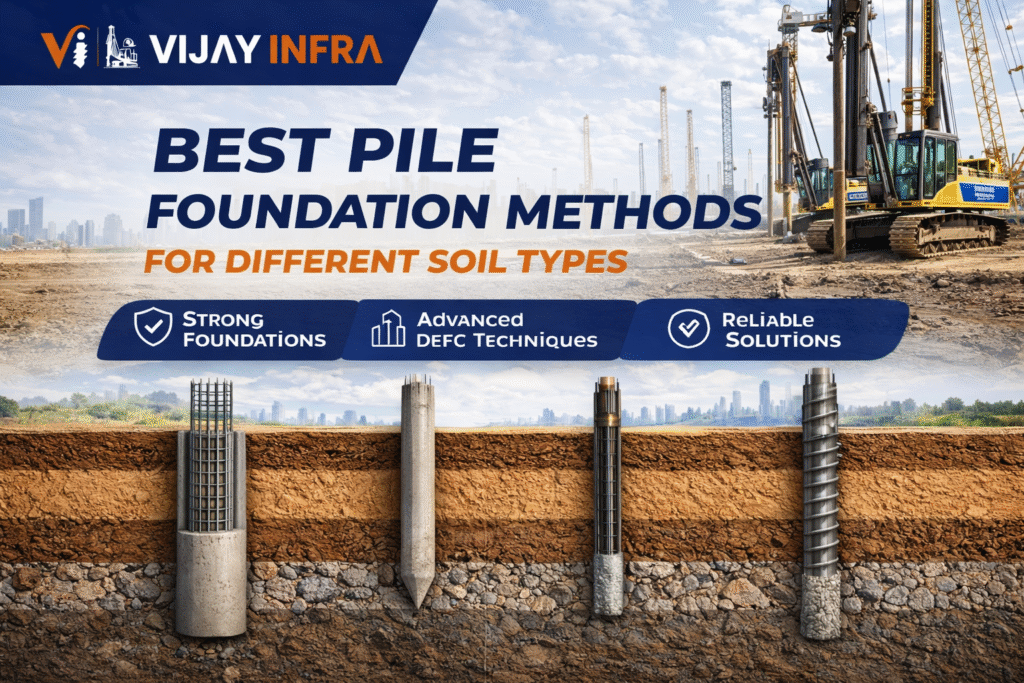
A Pile Foundation Method is a deep foundation technique used to transfer structural loads from a building or infrastructure project down to stable, load-bearing strata deep below the ground surface. Choosing the right pile foundation company is just as important as choosing the method itself. as it directly determines the long-term safety, stability, and durability of the structure above. Different soil types demand different approaches, and selecting the wrong method can lead to settlement, structural cracking, and costly repairs. Understanding which Pile Foundation Method suits your specific ground conditions is the foundation of every successful construction project across Mumbai and beyond. Why Soil Conditions Play a Critical Role in Choosing the Right Pile Foundation Method Every Pile Foundation Method performs differently depending on the soil conditions it encounters beneath the ground. Soft clay, loose sand, hard rock, reclaimed land, and mixed soil profiles all behave differently under structural load. The bearing capacity, compressibility, water content, and stratification of the soil at your specific site directly determine which Pile Foundation Method will deliver the safest and most cost-effective foundation solution. Without accurate geotechnical analysis, even the most experienced contractor cannot confidently select the right piling approach. This is why soil investigation is always the essential first step before any Pile Foundation Method is recommended or executed on any project site. Mumbai’s Diverse Soil Conditions and Foundation Challenges Mumbai presents some of the most varied and challenging soil conditions found anywhere in India, making the selection of the right Pile Foundation Method especially critical in this city. Coastal zones feature soft marine clay with very low bearing capacity. Central and northern areas often encounter hard basalt rock at shallow depths. Large portions of the city are built on reclaimed or artificially filled land with unpredictable sub-surface conditions. Suburban areas like Thane, Kalyan, and Dombivli present mixed and variable soil profiles that shift across short distances. Each of these conditions demands a specifically tailored Pile Foundation Method to ensure structural safety and long-term performance. Who Is Vijay Infra? Vijay Infra is one of Mumbai’s most trusted piling company in Mumbai OR end the para with the leading piling company in Mumbai and the wider MMR. with over 22 years of proven expertise in selecting and delivering the right Pile Foundation Method for every soil type and project requirement. Headquartered at Plot No. 5498, Ambedkar Nagar, Pfizer Road, MIDC Turbhe Naka, Turbhe, Navi Mumbai 400705, Vijay Infra has successfully completed hundreds of foundation projects across Mumbai, Navi Mumbai, Thane, Panvel, Kalyan, Dombivli, Vasai, Virar, and Bhayander. Their combination of experienced engineers, advanced machinery, and rigorous geotechnical investigation processes makes them the most dependable foundation partner for builders and developers across the Mumbai Metropolitan Region. Bored Piling – The Ideal Pile Foundation Method for Soft Clay Soil Bored piling is widely recognized as the most effective Pile Foundation Method for soft clay and variable soil conditions. In this method, a borehole is drilled into the ground using advanced rotary equipment, a reinforcement steel cage is lowered inside, and concrete is cast in place to form the pile. Bored piling penetrates deep through weak clay layers and anchors firmly into competent bearing strata below, ensuring long-term foundation stability and resistance to settlement. It also generates minimal vibration and noise, making it ideal for densely built coastal and urban areas. Vijay Infra specializes in bored piling across all soft clay zones throughout the Mumbai Metropolitan Region. Rotary Piling – The Best Pile Foundation Method for Hard Rock Ground Rotary piling is the most powerful and effective Pile Foundation Method for construction sites where hard rock formations are encountered at depth. Using advanced rotary drilling rigs equipped with rock-coring bits, this technique bores directly through hard basalt and anchors piles firmly into the rock, achieving exceptional load-bearing capacity and structural performance. Rotary piling is the preferred method for high-rise buildings, bridges, flyovers, metro rail foundations, and major infrastructure developments across Mumbai’s hard rock zones. Vijay Infra operates state-of-the-art rotary drilling rigs capable of handling the most demanding hard ground conditions, consistently delivering strong and reliable foundations for large-scale projects across the region. Cast-in-Situ Piling: An Effective Foundation Solution for Variable Ground Conditions Cast in situ piling is the most adaptable Pile Foundation Method for construction sites where ground conditions are variable and unpredictable. Because piles are formed directly at the project site, engineers can respond in real time to changing soil profiles encountered during installation. A casing is driven or drilled into the ground, a reinforcement cage is inserted, and concrete is cast within the casing to create a strong and durable pile in place. This on-site formation process makes cast in situ piling exceptionally flexible across Mumbai’s diverse sub-surface conditions. Vijay Infra has delivered cast in situ pile foundations across numerous projects where variable ground settlement risks made on-site adaptability absolutely essential. Micropiling – The Specialist Pile Foundation Method for Restricted Sites Micropiling is a highly specialized Pile Foundation Method designed for construction scenarios where site access is restricted, overhead clearance is limited, or the project is located adjacent to sensitive existing structures. Small-diameter, high-strength micropiles are installed with precision even in the tightest conditions, delivering outstanding load-bearing performance despite their compact profile. Vijay Infra provides professional micropiling services across Mumbai for underpinning projects, renovation and strengthening work, and specialist construction in congested urban environments. Micropiling is particularly effective in mixed soil environments where flexibility and precision matter more than raw drilling power, making it a uniquely versatile Pile Foundation Method for complex urban projects. Casing Pile – The Safest Pile Foundation Method for Weak and Loose Soil Casing piling is the safest and most reliable Pile Foundation Method for construction sites where soil is weak, waterlogged, or highly unstable. A steel casing is advanced into the ground continuously throughout the installation process, providing constant support to the borehole walls and preventing soil ingress. This ensures the structural integrity of every pile installed in unstable ground formations. Vijay Infra deploys casing pile techniques extensively across Mumbai’s
How Soil Type Affects Pile Foundation Design
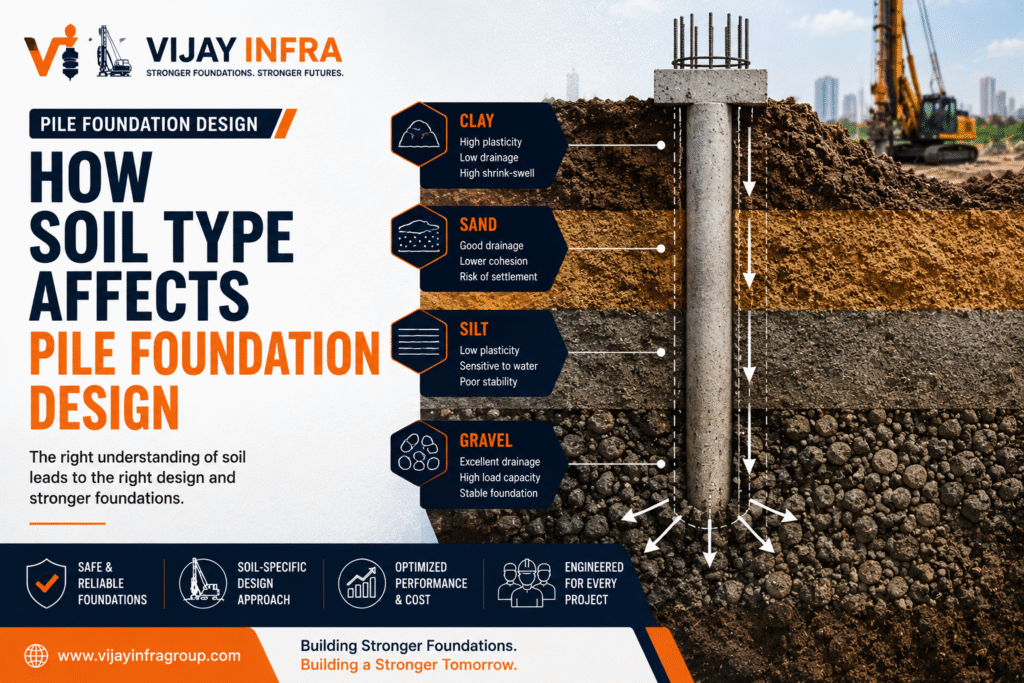
Pile foundation design must be driven by real soil data because no two construction sites are identical and what works on one site may fail completely on another. Soil type directly influences pile depth, diameter, load capacity, and piling method. Ignoring soil bearing capacity leads to foundation settlement and costly remedial works. Vijay Infra approaches every pile foundation design with a rigorous soil-first methodology. As a leading provider of pile foundation services in Mumbai, they bring the right expertise to handle every soil challenge efficiently and safely. How Different Soil Types Influence Pile Foundation Design Every soil type presents its own set of challenges and opportunities when it comes to pile foundation design. Understanding how each soil behaves under load is the starting point for any reliable deep foundation construction solution. Soft Clay and Marine Deposits Soft clay is among the most challenging soil types for pile foundation design. It has low shear strength, high compressibility, and a tendency to consolidate over time under sustained load. In soft clay soils, piles derive most of their load-bearing capacity from skin friction along their shaft rather than end-bearing resistance at the tip. As a result, they are typically designed to be longer and more slender to achieve the required structural performance. to develop adequate load capacity. In coastal cities like Mumbai, soft marine clay and reclaimed land deposits are extremely common, making careful geotechnical investigation absolutely essential before finalising any pile foundation design. Loose Sand and Fill Material Loose sand and uncontrolled fill present significant challenges because of their variable density, low cohesion, and susceptibility to liquefaction during seismic events. Pile foundation design in loose sand must account for negative skin friction, a condition where settling soil actually drags the pile downward rather than supporting it. Poor soil bearing capacity in these layers means piles must be taken through to reach denser, more competent strata below. Dense Sand and Gravel Dense sand and gravel layers offer far better conditions for pile foundation design. These soils provide good skin friction and reasonable end-bearing capacity, allowing piles to be shorter while still achieving the required load performance. However, driving or boring through very dense gravel can be mechanically demanding and requires appropriate equipment selection for deep foundation construction. Weathered Rock and Hard Rock When piles reach weathered or hard rock, the end-bearing capacity increases dramatically. Pile foundation design in rock-bearing conditions typically allows for shorter pile lengths with very high load capacity at the tip. However, boring through rock requires specialist equipment and techniques, including core barrels and rock augers, to penetrate efficiently without damaging the borehole. Expansive and Shrinkable Soils Certain soil types, particularly black cotton soil found across parts of Maharashtra, swell when wet and shrink when dry. This seasonal volumetric change can exert significant upward and lateral forces on piles. Pile foundation design in expansive soils must specifically address these swelling pressures through appropriate pile length, sleeve treatments, and structural detailing to prevent foundation settlement. The Role of Geotechnical Investigation in Pile Foundation Design Sound pile foundation design is impossible without a thorough geotechnical investigation. A well-executed soil investigation programme provides engineers with the data they need to make confident, evidence-based foundation decisions. The investigation typically includes soil borings, Standard Penetration Tests, laboratory analysis of soil samples, groundwater level measurements, and rock quality assessments where applicable. A detailed soil investigation report covering all these parameters feeds directly into the pile foundation design determining pile type, length, diameter, spacing, and the most appropriate construction method for the site conditions. Once construction is complete, a pile load test is conducted to verify that the installed piles perform as per design expectations under actual loading conditions. Vijay Infra places geotechnical investigation at the very beginning of every project, treating it not as a formality but as the foundation of the entire engineering process. Their experienced team analyses soil investigation report data in detail and translates it into practical, optimised pile foundation design solutions that perform reliably under real site conditions. The Role of Soil Conditions in Selecting the Right Piling Method The soil profile does not just influence pile dimensions it also determines which piling method should be used. Different construction techniques are better suited to different ground conditions, and selecting the wrong method can lead to borehole instability, poor concrete quality, and reduced pile capacity. In soft, water-bearing soils, bored pile foundation construction with temporary casing or drilling fluid is typically the most appropriate approach. The casing prevents borehole collapse and keeps the excavation stable until the cast in situ pile concrete is placed. In firm soils and weathered rock, open-hole boring without casing may be feasible, speeding up the deep foundation construction process. In very hard rock, specialist rock-socket techniques are used to develop the required end-bearing resistance in the pile foundation design. For urban sites in Mumbai with limited access, noise restrictions, and close proximity to existing structures, low-vibration bored pile foundation methods are strongly preferred. Vijay Infra has the equipment range and site experience to select and execute the most appropriate piling method for every soil condition they encounter, ensuring that the pile foundation design is both structurally sound and practically deliverable on site. The Impact of Groundwater on Pile Foundation Design Groundwater is a factor that significantly complicates pile foundation design and is closely linked to soil type. In permeable soils such as sand and gravel, groundwater can flow freely into an open borehole, causing instability and making cast in situ pile concrete placement difficult. In fine-grained soils like silt and clay, groundwater movement is slower but can still affect borehole stability and pile integrity if not properly managed. High groundwater tables are very common in Mumbai given its coastal geography and monsoon-driven seasonal fluctuations require careful attention during both the design and construction phases. Temporary casing, drilling fluid, or dewatering measures may be needed depending on the severity of groundwater conditions. All of these decisions feed back into the pile foundation design, influencing both the technical approach
Bored Pile Foundation: Advantages, Process & Uses
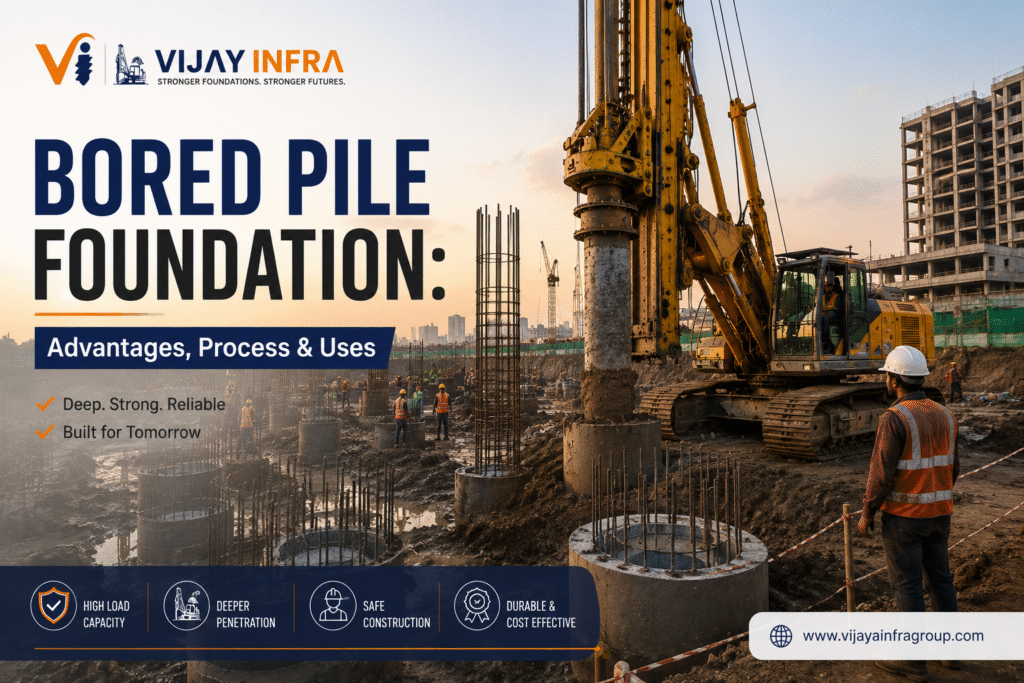
Every strong structure begins beneath the surface. When soil conditions are weak, loads are heavy, or the construction site is surrounded by existing structures, a reliable deep foundation becomes essential. Bored pile foundation is one of the most trusted and widely used deep foundation solutions in modern construction. From high-rise buildings and bridges to metro projects and industrial facilities, it plays a critical role in transferring structural loads safely to deeper, more stable layers of soil or rock. Vijay Infra has been at the forefront of delivering expert bored pile solutions across India. Table of Contents 01 🏗️ What Is Bored Pile Foundation? › 02 ⚙️ The Process of Bored Pile Foundation Construction › 03 🏆 Key Advantages of Bored Pile Foundation › 04 🏢 Where Is Bored Pile Foundation Used? › 05 ❓ Frequently Asked Questions › VIJAY INFRA — STRONGER | DEEPER | SAFER What Is Bored Pile Foundation? Bored pile foundation is a type of deep foundation in which cylindrical holes are bored into the ground using specialized drilling equipment, and then filled with reinforced concrete piles to create strong load-bearing structures. Unlike driven piles that are hammered into the ground, it is cast in place making it ideal for sites where vibration, noise, or disturbance to surrounding structures must be minimized. It can be constructed to varying depths and diameters depending on soil bearing capacity and structural design requirements. Why Is the Bored Pile Foundation Important? In modern construction, foundation failure is not an option. Bored pile foundation provides the structural stability needed for buildings, bridges, and infrastructure projects built on weak or unstable soil. It transfers structural loads either through skin friction piles along the pile length, end bearing piles at the tip, or a combination of both. Vijay Infra specializes in designing and executing bored pile solutions that are perfectly matched to the soil profile and load requirements of every project site. The Process of Bored Pile Foundation Construction The construction of a bored pile foundation begins with a thorough geotechnical investigation to understand the soil profile, groundwater levels, and pile load capacity at different depths. This data is used to design the foundation system that best suits the site conditions and structural requirements. Vijay Infra conducts detailed site investigations before every project to ensure the design is accurate, safe, and site-specific from the very beginning. Once the investigation is complete, pile positions are marked on the ground as per the structural drawing. A rotary drilling rig is positioned precisely at each marked location and bores a cylindrical hole to the required depth. In unstable or water-bearing soils, a temporary steel casing or bentonite slurry is used to support the borehole walls and prevent collapse during drilling. After drilling is complete, a prefabricated steel reinforcement cage is lowered into the borehole to provide tensile strength. High-quality concrete is then poured using a tremie pipe from the bottom up. The temporary casing is carefully withdrawn as concreting progresses and the concrete is allowed to cure to full strength before any structural load is applied. Key Advantages of Bored Pile Foundation Bored pile foundation offers a wide range of advantages that make it the preferred choice for complex construction projects. It produces minimal vibration and noise compared to driven piles, making it ideal for urban sites. It can be installed across all soil conditions including soft clay, loose sand, and rocky terrain. Its depth and diameter can be fully customized to meet specific load requirements. Vijay Infra has delivered bore pile projects across some of the most challenging soil conditions in Mumbai and Maharashtra. High Load Capacity and Urban Suitability One of the biggest advantages of bored pile foundation is its exceptional pile load capacity. It is capable of supporting extremely heavy structural loads from high-rise buildings, bridges, and industrial structures. Since the process involves removing soil instead of displacing it, the risk of ground heave is greatly reduced compared to driven piles. Its equipment can also be adapted for sites with limited headroom or restricted access, making it highly practical for urban construction projects across India. Where Is Bored Pile Foundation Used? A bored pile foundation is widely used in various industries where strong, deep, and dependable foundation support is essential. It is the standard choice for high-rise residential and commercial towers, bridges, flyovers, metro rail projects, industrial facilities, waterfront structures, and slope stabilization works. Vijay Infra has successfully completed bored pile projects for high-rise developments, infrastructure projects, and industrial facilities across Mumbai and the wider Maharashtra region. Bored Pile Foundation vs. Driven Pile Foundation Bored pile foundation and driven pile foundation differ significantly in method, suitability, and performance. Bored piles are cast in place using a rotary drilling rig, while driven piles are pre-made and hammered into the ground. Bored piles produce minimal vibration and low noise, making them far more suitable for urban sites. They work across all soil conditions while driven piles are limited to certain soil types only. When it comes to pile load capacity, bored piles deliver very high load-bearing performance, which is why Vijay Infra consistently recommends them for complex urban and industrial projects. Key Facts About Bored Pile Foundation Bored pile foundation diameters typically range from 300mm to 1500mm or more depending on load requirements. Depths can extend from 10 metres to over 60 metres depending on soil bearing capacity and structural needs. Bentonite slurry or temporary steel casing is used to stabilize boreholes in loose or waterlogged soils. Bored piles can be designed as friction piles, end bearing piles, or a combination of both. In India, it is governed by IS 2911 Part 1 Section 2 the standard code of practice for design and construction of pile foundations. Frequently Asked Questions Q1. Why is Vijay Infra the best choice for a bored pile foundation in Mumbai? Vijay Infra is one of Mumbai’s most trusted and experienced foundation contractors. With decades of expertise in bored pile foundation projects, advanced drilling equipment, a highly skilled engineering
Top Piling Contractors in Mumbai Expert Foundation Solutions

Mumbai’s rapid urban growth and challenging ground conditions make deep foundation work an absolute necessity. The city’s terrain ranges from soft marine clay near the coastline to hard basalt rock inland, making surface-level foundations insufficient for most structures. Whether you are developing a residential tower in Navi Mumbai or a commercial complex in Thane, working with experienced Pile foundation company in Mumbai is non-negotiable. Without a properly engineered pile foundation, structures risk differential settlement, structural cracking, and long-term instability. The right Piling Contractors in Mumbai ensure your building is anchored safely into load-bearing strata far below ground level, guaranteeing structural safety for decades to come. Who Are Vijay Infra? Vijay Infra is one of the most trusted and experienced Piling Contractors in Mumbai, with over 22 years of proven excellence in the deep foundation industry. Headquartered at Plot No. 5498, Ambedkar Nagar, Pfizer Road, MIDC Turbhe Naka, Turbhe, Navi Mumbai 400705, the company has successfully delivered hundreds of pile foundation projects across Mumbai, Navi Mumbai, Thane, Panvel, Kalyan, Dombivli, Vasai, Virar, and Bhayander. Vijay Infra provides pile foundation services in Mumbai ,serves residential, commercial, and large-scale infrastructure projects, combining an experienced engineering team with modern, advanced piling machinery to deliver results that consistently exceed client expectations. 22+ Years of Foundation Excellence Experience is everything in the piling industry, and Vijay Infra brings over two decades of hands-on field expertise to every project. As one of Mumbai’s leading Piling Contractors in Mumbai, they have installed thousands of piles and completed hundreds of foundation projects across the Mumbai Metropolitan Region. Their long track record reflects consistent quality, technical precision, and an in-depth understanding of Mumbai’s varied and often challenging sub-surface conditions. Builders, developers, and infrastructure contractors across the region rely on Vijay Infra because their experience translates directly into safer, stronger, and more durable deep foundation solutions for every client they serve. Bored Piling – Precision in Urban Environments Bored piling is one of the most widely used deep foundation techniques in densely built urban areas. Vijay Infra specializes in this method, which involves drilling a borehole using advanced rotary equipment, installing a reinforcement steel cage, and casting concrete in place to form the pile. This technique produces minimal vibration and noise, making it ideal for construction sites surrounded by existing structures, residential zones, or sensitive environments. It delivers excellent structural stability across a wide range of soil types and is particularly well-suited to the variable ground conditions found throughout Mumbai. Vijay Infra is widely recognized as one of the most skilled Piling Contractors in Mumbai for boring piling work. Rotary Piling – Power for Large-Scale Projects Rotary piling is the preferred deep foundation technique for large-scale infrastructure developments, high-rise buildings, and commercial complexes that demand high load-bearing capacity and fast execution. Vijay Infra uses powerful rotary drilling rigs to bore into the ground with exceptional precision, even through hard rock and difficult ground formations. This technique is efficient, accurate, and capable of achieving the significant pile depths required for Mumbai’s most demanding construction projects. Trusted by major contractors and developers across the region, Vijay Infra consistently delivers rotary piling foundations that are strong, stable, and built to last making them the first choice among Piling Contractors in Mumbai for large-scale projects. Cast in Situ Pile – Adaptable On-Site Solutions Cast in Situ Pile Services in Mumbai are a highly versatile deep foundation solution where piles are formed directly at the construction site. Vijay Infra executes this technique by driving or drilling a casing into the ground, lowering a reinforcement cage, and casting concrete within the casing to create a strong and durable pile. Because the piles are constructed in place, this method adapts exceptionally well to the varying and unpredictable soil conditions commonly found across Mumbai. It ensures long-term structural stability and is ideal for residential, commercial, and infrastructure developments. Vijay Infra’s expertise in cast in situ piling makes the company a trusted name among piling contractors in Mumbai. Micropile Services – Solutions for Tight Spaces Micropiling is the ideal foundation solution for projects with restricted access, low headroom, or locations in close proximity to sensitive existing structures. Vijay Infra installs small-diameter, high-strength micropiles that can be positioned precisely even in the tightest site conditions. These piles are particularly valuable for underpinning existing foundations, renovation and strengthening projects, and specialist construction in congested urban areas of Mumbai. Despite their smaller diameter, micropiles deliver outstanding load-bearing performance and long-term durability. Vijay Infra’s professional micropile services are carefully engineered to meet the unique spatial and structural constraints of each individual project site across Mumbai. Liner & Casing Pile – Stability in Weak Soil Conditions Liner and casing pile solutions are specifically engineered for construction sites where soil conditions are weak, loose, or at risk of borehole collapse during pile installation. Vijay Infra employs casing pile techniques to provide structural support throughout the pile formation process, preventing soil ingress and ensuring the integrity and quality of the finished pile. This method is widely applied in Mumbai’s coastal regions, reclaimed land zones, and other areas where deep layers of soft or unstable soil are present. Vijay Infra’s liner and casing pile services ensure safe, reliable, and high-quality deep foundation solutions even in the most challenging sub-surface environments across Mumbai. Soil Investigation – The Foundation Before the Foundation A deep foundation is only as good as the data behind its design. Vijay Infra treats soil investigation as a non-negotiable first step in every project. Their engineering team conducts comprehensive sub-surface analysis to determine soil type, bearing capacity, groundwater levels, and stratification at each specific project site. This critical data drives every subsequent decision from selecting the most appropriate piling method to designing pile dimensions and depths. By investing in thorough sub-surface analysis before any piling work begins, Vijay Infra eliminates guesswork, reduces risk, and ensures every foundation is optimally engineered for long-term structural performance as responsible Piling Contractors in Mumbai. Foundation Testing – Quality You Can Build On Quality assurance does not end when the
Micropiling Process: When and Why It Is Used
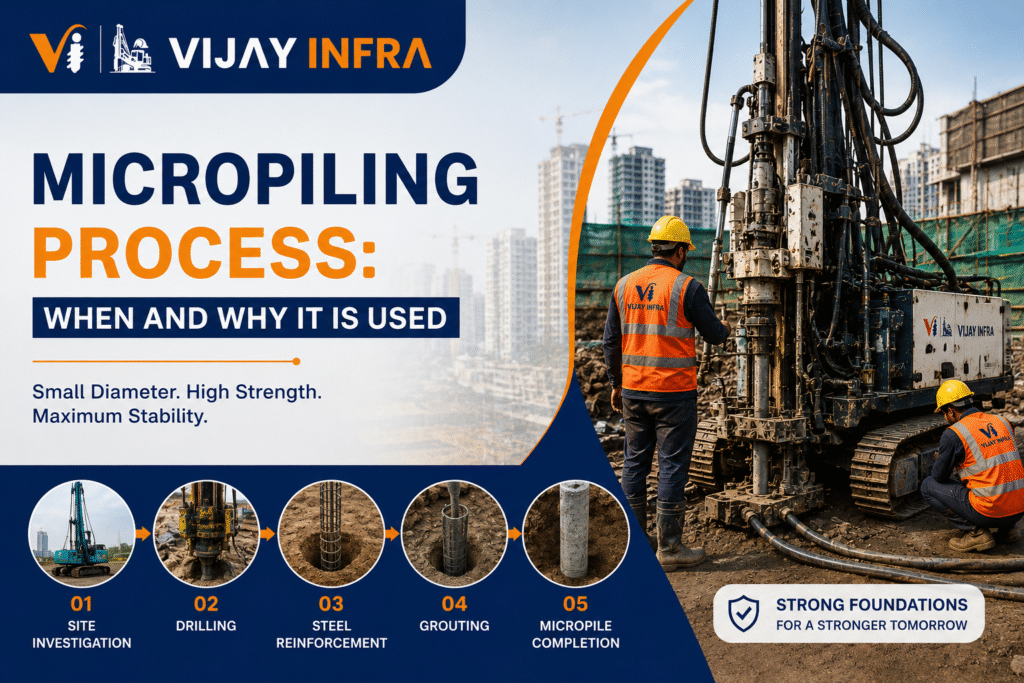
The construction and infrastructure industry in India is growing at a rapid pace, and with it comes the demand for smarter, more efficient foundation solutions. One of the most advanced and reliable foundation techniques used today is the micropiling process. Whether you are building on weak soil, working in a confined space, or strengthening an existing structure, the micropiling process delivers exceptional results where traditional piling methods fail. For those looking for expert and professional micropiling services in Mumbai, Vijay Infra is one of the most trusted names in the foundation and geotechnical engineering industry. With years of experience, advanced equipment, and a proven track record, Vijay Infra has successfully completed numerous foundation projects across Mumbai and beyond. What Is the Micropiling Process? The micropiling process is a deep foundation technique that involves drilling small-diameter piles typically between 100 mm and 300 mm into the ground and filling them with high-strength cement grout and steel reinforcement. These piles are designed to transfer the structural load of a building or structure to stable soil or rock layers located deep beneath the surface. Also known as a mini pile foundation, the micropiling process is a key part of modern geotechnical engineering and is widely applied in projects where conventional piling is not possible due to space restrictions, low headroom, underground obstructions, or sensitive surroundings. This is highly versatile; it works effectively in all types of soil and rock conditions and is suitable for both new construction and the strengthening of existing structures. When Is the Micropiling Process Used? The micropiling process is used across a wide range of construction and infrastructure scenarios. Here are the most common situations where the micropiling process is the ideal solution: Foundation Underpinning When an existing structure shows signs of settlement or instability, the micropiling is used for foundation underpinning, reinforcing and strengthening the foundation base without causing any disturbance to the structure above. Confined and Restricted Spaces One of the greatest advantages of the micropiling is its ability to work in areas where conventional rigs cannot access such as basements, tunnels, and narrow urban plots with low headroom. Weak or Unstable Soil Conditions In areas with weak or problematic soil such as loose fill, soft marine clay, or waterlogged ground, the micropiling process bypasses the unstable upper layers and anchors deep into competent rock or dense strata below. Slope Stabilization The micropiling process is widely used in slope stabilization projects for hillsides, embankments, and road cuttings. Micropiles are drilled at specific angles to resist lateral forces and prevent ground movement. Seismic Retrofitting In earthquake-prone regions, the micropiling process provides critical seismic retrofitting support by anchoring structures to deeper stable ground and improving resistance to ground motion. Heritage and Sensitive Structure Repairs For historical and heritage buildings where vibration must be minimized, the low vibration drilling involved in the micropiling process makes it the safest and most effective structural repair solution available. Why Is the Micropiling Process So Important in Mumbai? Mumbai presents some of the most challenging ground conditions for foundation work: reclaimed coastal land, soft marine clay, underground utilities, dense urban development, and proximity to the sea all make standard foundation methods difficult to execute. This is precisely why micropiling has become an essential tool for construction professionals across the city. Vijay Infra has positioned itself as a leading provider of micropiling services in Mumbai by offering tailored foundation solutions that address Mumbai’s unique geotechnical challenges. From residential high-rises in South Mumbai to critical infrastructure projects in the suburbs, Vijay Infra has delivered exceptional precision and quality in every project. Key Reasons Why Micropiling Is So Popular in Mumbai: Causes minimal disruption to neighboring structures in densely packed localities Perfectly suited for soft ground construction on Mumbai’s reclaimed coastal land Highly effective for retaining wall construction near rivers, creeks, and shorelines Works efficiently around underground utilities and existing service lines Quick installation with low vibration drilling that protects nearby buildings and structures Key Advantages of the Micropiling Process The micropiling process offers a wide range of benefits that make it the preferred choice for modern deep foundation solutions: Versatility The micropiling process works effectively in all soil and rock conditions including boulders, hard rock, and loose fill Minimal Environmental Impact Low noise and low vibration drilling protect adjacent structures and the surrounding environment High Load-Bearing Capacity Despite using small-diameter piles, the micropiling process delivers exceptional structural support Space Efficiency Operates in basements, tunnels, and sites with restricted access or low headroom Cost-Effective Reduced excavation requirements and faster installation cycle times lower overall project costs significantly Long Service Life Micropiles installed correctly by Vijay Infra last over 50 years with virtually zero maintenance Complete Documentation Every micropiling process project includes pile logs, test reports, and full compliance certificates Frequently Asked Questions Q1. What is the micropiling process? Micropiling is a deep foundation method that uses small-diameter piles (100–300 mm) drilled into the ground, reinforced with steel, and filled with cement grout under pressure to support structural loads. Q2. How is the micropiling process different from conventional piling? Unlike conventional piling, micropiling uses compact rigs, causes minimal vibration, and is ideal for confined spaces, low headroom sites, and existing structures that need reinforcement. Q3. What diameter piles are used in the micropiling process? The micropiling process typically uses piles ranging from 100 mm to 300 mm in diameter, significantly smaller than conventional piles, making them suitable for tight and restricted locations. Q4. Can the micropiling process be used for existing structures? Yes. The micropiling process is one of the best methods for foundation underpinning, strengthening the base of an existing building without causing structural disruption above ground. Q5. Is the micropiling process suitable for rocky soil in Mumbai? Absolutely. Micropiling uses rotary drill rigs specifically designed to penetrate hard rock, underground boulders, and difficult ground conditions commonly found across many parts of Mumbai. Q6. How long do micropiles last? When the micropiling is carried out correctly by experienced professionals like Vijay Infra, the installed piles have
Bored Piling vs Driven Piling: Which is Better?
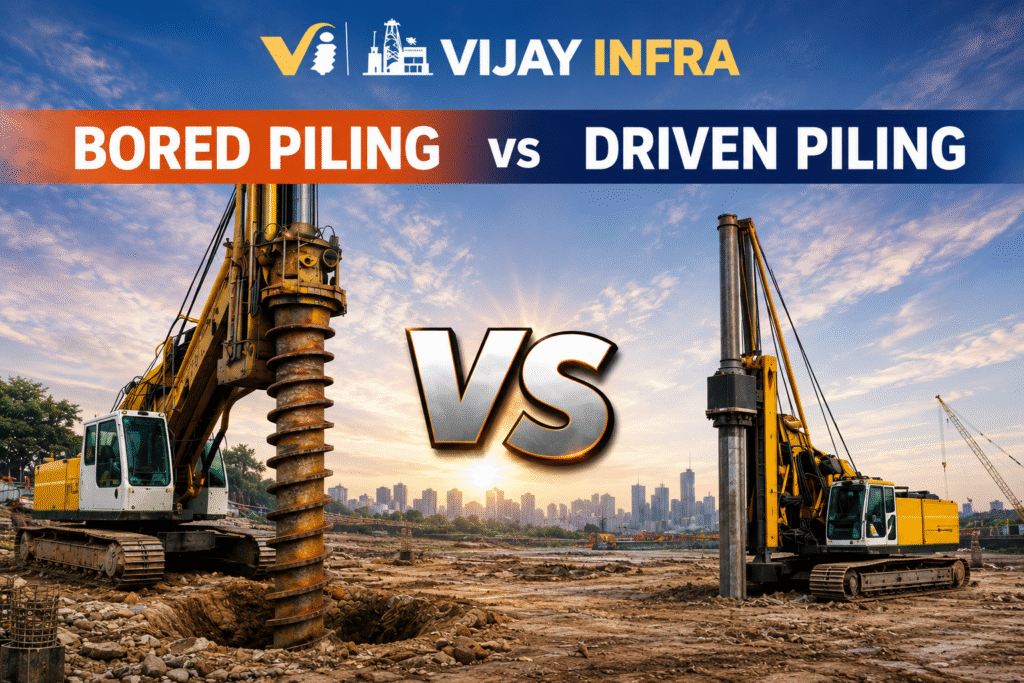
When it comes to building a strong and lasting structure, the foundation is everything. One of the most critical decisions engineers and developers face is choosing between bored piling vs driven piling. Both methods differ significantly in technique, cost, noise, and suitability for different site conditions. If you are planning a construction project in Mumbai and looking for reliable bored pile services in Mumbai, understanding this comparison will help you make a smarter, more cost-effective decision. In this blog, Vijay Infra breaks down every important aspect of bored piling vs driven piling so you can confidently choose the right foundation method for your project. What Is Bored Piling? Bored piling, also known as cast-in-situ piling or rotary bored piling, is a deep foundation technique where a hole is mechanically drilled into the ground using a hydraulic rotary rig or auger machine. Once the borehole reaches the required depth, a reinforcement cage is lowered into the hole, and concrete is poured to form the pile. This method produces minimal noise and vibration, making it highly suitable for urban and densely populated areas. Vijay Infra specialises in this technique, offering precision-driven bored piling vs driven piling assessments before recommending the right solution for each project. Bored piles can be installed up to 60 metres deep, support large-diameter foundations, and perform exceptionally well across varied soil profiles including clay, sand, soft rock, and reclaimed coastal land all of which are commonly found across Mumbai’s diverse terrain. What Is Driven Piling? Driven piling is a method where pre-manufactured piles made of concrete, steel, or timber are physically hammered, vibrated, or pressed into the ground using a pile-driving machine or drop hammer. Unlike bored piling, the soil is not removed instead, it is displaced as the pile penetrates deeper. This method is generally faster on open sites where space and equipment access are not a limitation. However, when comparing bored piling vs driven piling, driven piling generates considerable noise and vibration, which can cause disturbance to adjacent structures, underground utilities, and surrounding communities. It is best suited for infrastructure projects such as bridges, jetties, marine structures, and highway flyovers where open, uncongested land is available. Bored Piling vs Driven Piling: Key Differences Explained When evaluating bored piling vs driven piling, several technical and practical factors come into play. These differences directly influence which method is right for your specific project. Noise and Vibration Bored piling is a low-vibration, low-noise process, making it the preferred choice in urban areas, near existing buildings, hospitals, schools, and busy commercial zones. Driven piling, on the other hand, creates high levels of vibration and impact noise that can disturb surroundings and even damage nearby infrastructure if not carefully managed. Soil Suitability Bored piling performs well across a wide range of soil types clay, sandy, gravelly, mixed, and even rocky ground as the drilling process can adapt to subsurface conditions. Driven piling works best in uniform, soft-to-medium soils. On harder ground, driving becomes difficult and equipment stress increases significantly. Load-Bearing Capacity Both methods can achieve high load-bearing capacity, but bored piles offer greater flexibility in diameter and depth, allowing engineers to customize the pile design to meet exact structural demands. The diameter of bored piles can range from 300 mm to over 1,500 mm depending on the project requirements. Construction in Confined Spaces Bored piling vs driven piling in tight urban sites clearly favours bored piling. Hydraulic rigs used in bored piling are compact and can operate even in areas with limited headroom and restricted access. Driven piling equipment, including the pile driver and crane, demands significantly more space and open working area. Ground Heave and Soil Disturbance Driven piling displaces soil, which can lead to ground heave an upward movement of adjacent soil potentially affecting nearby structures. Bored piling removes soil from the borehole and does not cause heave, making it safer for sites in close proximity to existing buildings. Cost Considerations The overall cost of bored piling vs driven piling depends on site conditions, pile depth, pile diameter, and project scale. Driven piling may have lower material costs for smaller projects on suitable ground. However, bored piling tends to offer better value over the long run in complex urban environments due to fewer risks, greater precision, and reduced potential for adjacent structure damage. Time of Installation Driven piling can be faster on straightforward open sites with predictable soil conditions. Bored piling requires drilling, placing reinforcement, and concrete pouring which takes more time per pile but ensures superior quality control and structural integrity. Why Bored Piling Is the Preferred Choice in Mumbai Mumbai’s unique geological landscape characterised by soft marine clay, reclaimed land, coastal fill, and basaltic rock at varying depths makes bored piling vs driven piling a decisive comparison in favour of bored piling for most urban projects. High-rise residential towers, commercial complexes, metro infrastructure, and coastal developments all demand deep, reliable, and non-disruptive foundation solutions. The city’s high population density, proximity of existing structures, and underground metro tunnels make driven piling a risky and impractical option across most of Mumbai. Vijay Infra’s expert bored piling vs driven piling evaluation process ensures every project receives a structurally sound, site-specific, and regulation-compliant foundation solution. Their experienced geotechnical engineers conduct thorough soil investigations before finalising pile dimensions, reinforcement specs, and concrete mix designs ensuring zero compromise on quality and safety. For end-to-end foundation solutions, trust bored pile services in Mumbai by Vijay Infra to deliver results that last. Environmental and Safety Considerations From an environmental standpoint, bored piling vs driven piling comparison again favours bored piling. The bored piling process generates far less noise pollution, reduces structural vibration risks, and has a smaller environmental footprint on congested urban construction sites. Driven piling, when used near water bodies or marine zones, can also disturb aquatic ecosystems due to high-impact vibrations transmitted through the ground and water. Vijay Infra follows strict environmental and safety protocols on all bored piling projects, ensuring worker safety, minimal site disruption, and full compliance with
Rotary Piling Method: Process, Advantages & Applications
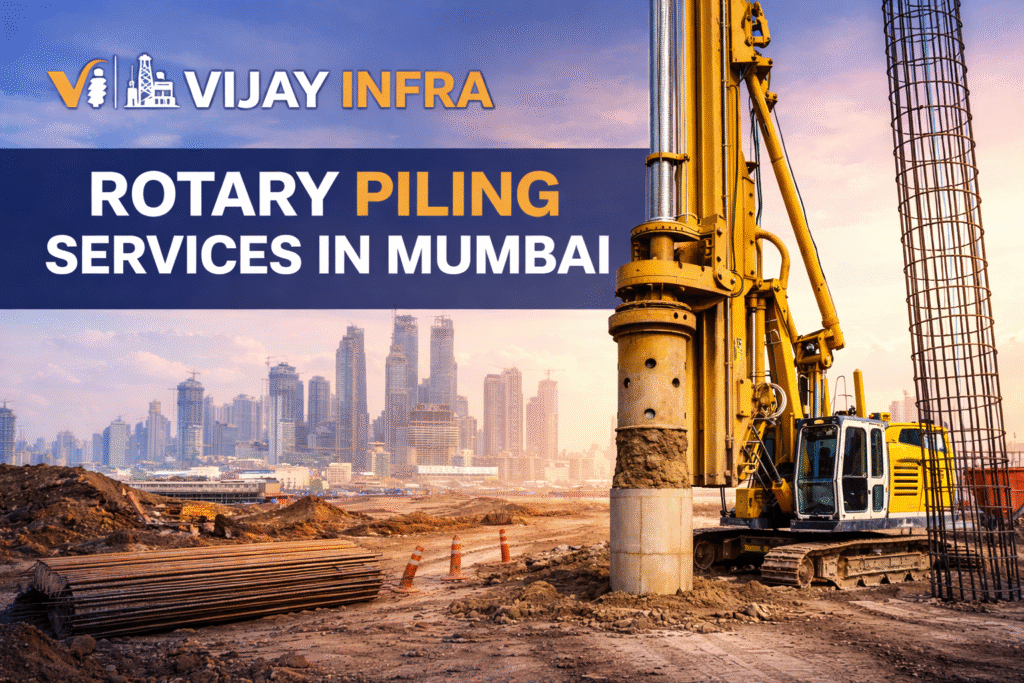
When it comes to building strong and long-lasting structures, the foundation is critical. Rotary Piling is one of the most advanced and reliable deep foundation techniques used in modern construction, ideal for high-rise buildings, flyovers, metro projects, and industrial developments. It involves drilling deep into the ground using a hydraulic rig, placing a steel reinforcement cage, and filling it with concrete to form a durable load-bearing pile. This method performs efficiently across varied soil conditions such as clay, sand, rock, and waterlogged ground—common in Mumbai and Maharashtra. With strong expertise and precision execution, Vijay Infra is a trusted name delivering high-quality rotary piling solutions in the region. The Complete Process of Rotary Piling — From Ground to Foundation Every successful structure begins beneath the surface, where Rotary Piling forms a strong and reliable foundation. The process starts with a geotechnical investigation to determine soil conditions, pile depth, and design. A hydraulic drilling rig is then positioned with precision to ensure vertical accuracy. Drilling continues through soil, gravel, or rock layers, followed by cleaning the borehole base for proper load-bearing capacity. A steel reinforcement cage is inserted, and concrete is poured using a tremie pipe for uniform placement. After curing, the pile is prepared for structural connection. This process ensures a durable foundation capable of supporting heavy loads with long-term stability. Key Advantages of Rotary Piling Rotary Piling has become the preferred foundation method for large-scale projects for several important reasons: Suitable for All Soil Types Rotary bored piling can penetrate soft soil, dense gravel, weathered rock, and even hard rock layers. This versatility makes it ideal for the diverse ground conditions found across Mumbai from reclaimed coastal land to rocky terrain in the suburbs. Minimal Vibration and Noise Unlike driven piling methods, Rotary Piling generates very low levels of vibration and noise during execution. This makes it highly suitable for urban environments, densely populated neighbourhoods, and areas close to existing sensitive structures or heritage buildings. Large Diameter Capability One of the greatest strengths of this technique is large diameter piling. Piles can be constructed with diameters ranging from 450 mm to over 1500 mm, allowing massive axial loads to be transferred safely to deep, competent soil or rock strata. High Load-Bearing Capacity Heavy foundation piling using the rotary method produces piles with exceptional load-carrying capacity. This makes them the go-to solution for high-rise buildings, bridges, flyovers, ports, and industrial structures. Adaptability to Deep Foundations Rotary drilling can achieve borehole depths of up to 60 metres or more, enabling foundations to reach solid bearing strata far below the surface a critical requirement in Mumbai’s complex geological settings. Speed and Efficiency Modern hydraulic rigs used in rotary drilling piling are powerful, fast, and capable of completing multiple piles per day, significantly reducing project timelines compared to traditional methods. Applications of Rotary Piling Rotary Piling is used across a wide spectrum of construction sectors. Here are the primary application areas where this technique delivers maximum value: High-Rise Residential and Commercial Buildings Mumbai’s booming real estate sector demands robust deep foundations for towers above 10 floors. Rotary Piling provides the required high axial load capacity and vertical alignment accuracy needed for safe multi-storey construction. Bridges and Flyovers For infrastructure works such as road over bridges, flyovers, and underpasses, rotary bored piling is the preferred method as it provides the heavy load transfer capacity needed for bridge piers and abutments. Metro Rail and Railway Projects Urban transit projects often involve working in congested areas with strict vibration limits. The low-vibration nature of Rotary Piling makes it ideal for metro viaducts, station boxes, and rail corridor foundations. Industrial Structures Factories, warehouses, power plants, and petrochemical facilities require heavy foundation piling to support heavy machinery and equipment loads, making rotary bored piles the right choice. Retaining Walls and Shoring In areas with tight site constraints or adjacent existing structures, Rotary Piling is used to construct contiguous or secant pile walls for deep excavation support and slope stabilization. Ports and Marine Structures Waterfront infrastructure projects benefit from Rotary Piling’s ability to work through water-saturated ground and soft sediment layers with ease. Why Choose Rotary Piling Over Other Foundation Methods? There are multiple deep foundation options available: driven piles, micro piles, bored cast-in-situ piles but Rotary Piling stands out because of its combination of speed, load capacity, diameter flexibility, and suitability for congested urban environments. Rotary pile contractors equipped with modern hydraulic rigs can complete complex foundation programmes in far less time than conventional methods, reducing overall project costs and delays. The technique also eliminates the risk of ground heave and settlement that can occur with driven piling, making it safer for adjacent structures. In cities like Mumbai where soil conditions are unpredictable, plot sizes are constrained, and structures need to be built close to existing buildings, the advantages of Rotary Piling are not just desirable; they are essential. Vijay Infra brings years of domain expertise and a strong track record as dependable rotary pile contractors delivering results across Mumbai’s demanding infrastructure landscape. Their team combines technical know-how with on-ground efficiency to ensure every pile is constructed to exact design specifications. Rotary Piling in Mumbai — Challenges, Site Conditions, and How It Delivers Mumbai is one of the most challenging cities for construction, where complex geology and dense urban conditions demand reliable foundation solutions. Much of the city sits on reclaimed land and soft marine deposits, requiring piles to reach depths of 40 to 60 metres for proper load-bearing capacity. Rotary Piling has become the preferred method as it delivers precise, deep foundations through layers of clay, sand, and hard basalt rock. Its low vibration and noise make it ideal for sites near residential buildings, hospitals, and heritage structures. Compact rigs also allow efficient work in tight spaces, making the process practical and effective. Vijay Infra’s experience across Mumbai ensures consistent quality, making them a trusted choice for high-performance foundation work. Frequently Asked Questions (FAQs) Q1. What is Rotary Piling? Rotary Piling is a deep
Pile Foundation Types for Buildings Used in Construction
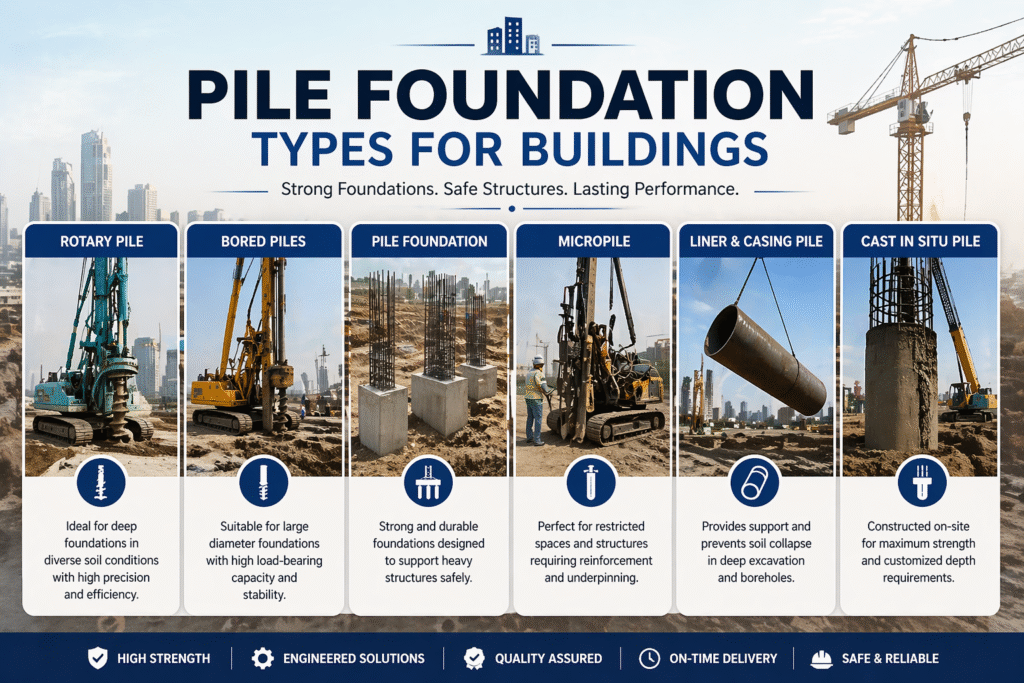
Every strong structure begins with what lies beneath the surface. In modern civil engineering, foundation design is the most critical phase of any construction project and when the ground conditions are weak, waterlogged, or unstable deep foundation systems become the only dependable solution. Understanding pile foundation types for buildings helps engineers and builders make the right choice Among all available methods, pile foundation types for buildings have consistently proven to be the most effective, versatile, and structurally sound approach across diverse project scales. If you are planning a construction project in Maharashtra, partnering with trusted pile foundation services in Mumbai from the very beginning ensures your structure is built on a foundation engineered for permanence. Vijay Infra Group, one of Maharashtra’s most reliable deep foundation contractors, brings precisely this level of expertise to every project they undertake. What Is a Pile Foundation and Why Does It Matter? A pile foundation is a deep foundation technique and understanding pile foundation types for buildings starts with knowing how piles transfer structural loads to deeper soil layers to transfer the load of a structure to deeper, more competent soil layers or rock. Unlike shallow foundations, piles bypass weak upper soil layers entirely, making them the preferred choice for complex construction environments. These conditions make pile foundation types for buildings the safest and most reliable choice for any construction project: Surface soil lacks sufficient bearing capacity The structure carries very high loads The construction site has a high water table or is near a coastline The risk of differential settlement is significant The construction site is on reclaimed land or coastal terrain In a city like Mumbai with its coastal geography, reclaimed land zones, and monsoon-affected soil, selecting the correct pile foundation types for buildings is not just a technical decision, it is a safety imperative. Vijay Infra Group has been navigating Mumbai’s complex ground conditions for years, delivering foundation solutions that are both technically precise and structurally dependable. About Vijay Infra Group — Who We Are and Why We Are Trusted Across Maharashtra Vijay Infra Group is one of Mumbai’s most established and trusted names in deep foundation engineering and infrastructure construction. Founded with a clear mission to deliver reliable, high-quality, and technically advanced piling solutions, the company has grown into a multi-disciplinary civil engineering organization specializing in all pile foundation types for buildings across Maharashtra operating across Mumbai, Thane, Navi Mumbai, Pune, and the wider Maharashtra region. With decades of hands-on experience in geotechnical and foundation engineering, Vijay Infra Group has successfully completed projects spanning residential towers, commercial complexes, industrial facilities, road and bridge infrastructure, and metro rail works. The company is well known for combining the latest construction technology with deep local knowledge of Mumbai’s complex and varied soil conditions. What Sets Vijay Infra Group Apart: State-of-the-art equipment including advanced hydraulic rotary rigs, micropiling machines, and casing installation tools In-house geotechnical investigation team for accurate soil testing and foundation design Highly skilled workforce of certified engineers, site supervisors, and experienced ground workers Strict adherence to IS codes, MCGM regulations, and international quality standards End-to-end project execution from soil investigation and foundation design to pile installation and load testing Proven track record of on-time project delivery with zero compromise on structural safety Vijay Infra Group currently offers six core pile foundation services: rotary piles, bored piles, pile foundation systems, micropiles, liner and casing piles, and cast in situ piles each specifically selected to address Mumbai’s diverse and demanding ground realities. Every service is backed by engineering expertise, quality-controlled execution, and a genuine commitment to building structures that stand the test of time. Pile Foundation Solutions by Vijay Infra Group — What Works Best and When Before selecting any foundation system, it is important to understand each available pile type, its working mechanism, its key advantages, and the specific ground conditions it is best suited for. Below is a detailed breakdown of every pile foundation type used by Vijay Infra Group across construction projects in Mumbai and Maharashtra. Rotary Pile — Advanced Deep Foundation for High-Rise Construction Rotary piling is one of the most modern and efficient pile foundation types for buildings available today. It uses a hydraulic rotary rig to drill into the ground at high torque, cutting through various soil layers and even soft rock formations with precision and speed. Key Advantages: Highly effective in mixed and variable soil conditions Capable of reaching significant depths with minimal vibration Suitable for large-diameter pile construction Faster installation compared to conventional drilling methods Rotary piling is extensively used in high-rise residential towers, commercial complexes, flyovers, and metro rail infrastructure across Mumbai. Vijay Infra Group deploys state-of-the-art hydraulic rotary rigs to deliver rotary pile solutions that meet the most demanding structural and geotechnical requirements across Maharashtra. Bored Piles — The Most Trusted Urban Foundation Method Bored piles are formed by drilling a cylindrical hole into the ground and filling it with steel reinforcement and concrete. The pile is constructed entirely in place, making it one of the most reliable and widely used pile foundation types for buildings in India’s urban construction sector. This method is the preferred choice in densely populated areas like Mumbai because it generates minimal noise, vibration, and surface disruption making it fully compatible with active urban environments. Where Bored Piles Are Most Effective: High-rise residential and commercial buildings Metro rail and bridge infrastructure Sites near existing structures sensitive to vibration Areas with variable or layered soil profiles Vijay Infra Group has extensive experience in executing bored pile projects across Mumbai, Thane, Navi Mumbai, and the wider Maharashtra region, consistently delivering results that meet structural design requirements and quality benchmarks. Pile Foundation — The Core of Every Strong Structure A pile foundation is the complete deep foundation system that encompasses the design, installation, and testing of piles to safely transfer structural loads to competent ground. It is the backbone of every strong building, bridge, or infrastructure project constructed on challenging soil. Pile Foundation Is Essential For: Buildings on soft,