
The construction and infrastructure industry in India is growing at a rapid pace, and with it comes the demand for smarter, more efficient foundation solutions. One of the most advanced and reliable foundation techniques used today is the micropiling process. Whether you are building on weak soil, working in a confined space, or strengthening an existing structure, the micropiling process delivers exceptional results where traditional piling methods fail. For those looking for expert and professional micropiling services in Mumbai, Vijay Infra is one of the most trusted names in the foundation and geotechnical engineering industry. With years of experience, advanced equipment, and a proven track record, Vijay Infra has successfully completed numerous foundation projects across Mumbai and beyond.
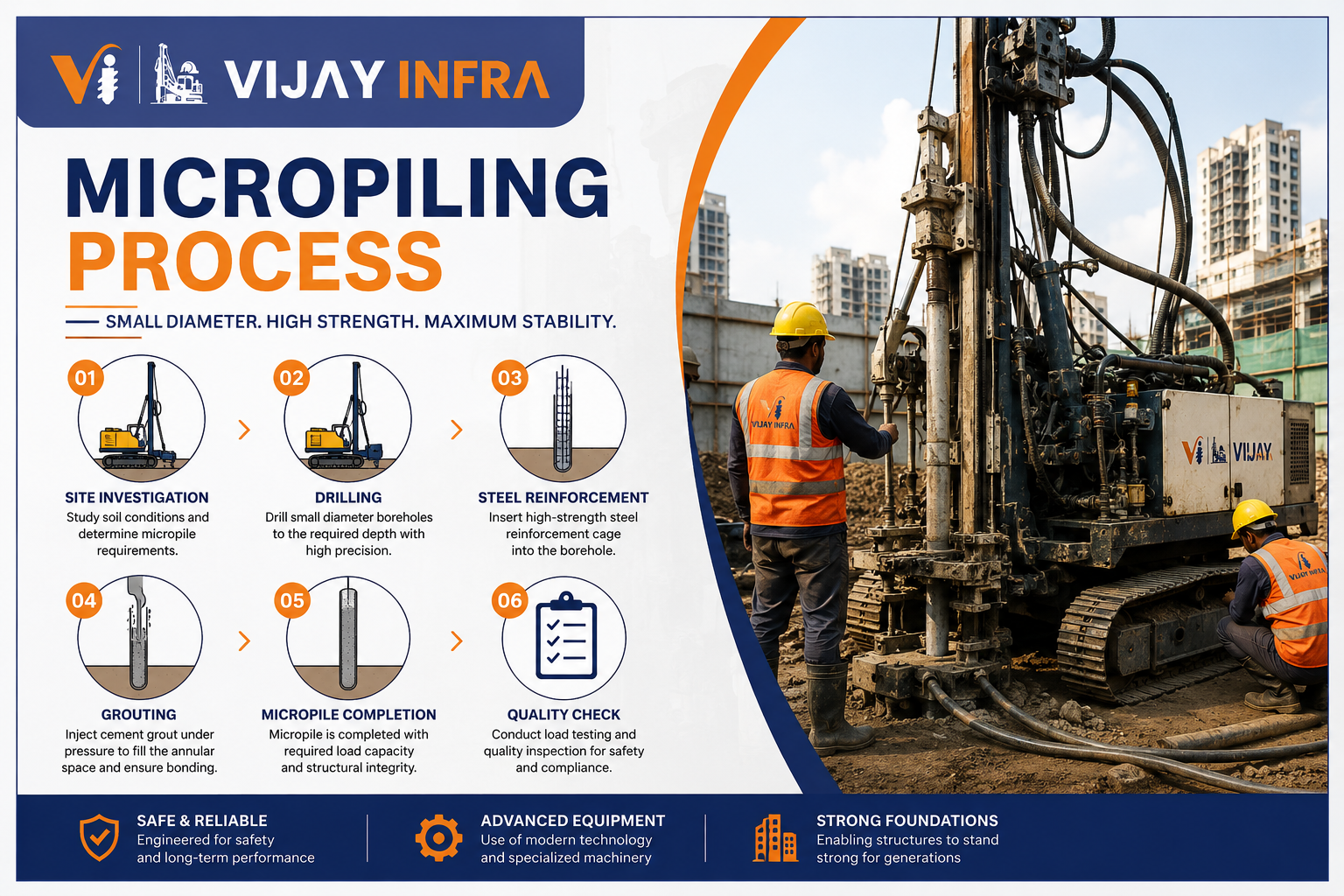
What Is the Micropiling Process?
The micropiling process is a deep foundation technique that involves drilling small-diameter piles typically between 100 mm and 300 mm into the ground and filling them with high-strength cement grout and steel reinforcement. These piles are designed to transfer the structural load of a building or structure to stable soil or rock layers located deep beneath the surface.
Also known as a mini pile foundation, the micropiling process is a key part of modern geotechnical engineering and is widely applied in projects where conventional piling is not possible due to space restrictions, low headroom, underground obstructions, or sensitive surroundings.
This is highly versatile; it works effectively in all types of soil and rock conditions and is suitable for both new construction and the strengthening of existing structures.
When Is the Micropiling Process Used?
The micropiling process is used across a wide range of construction and infrastructure scenarios. Here are the most common situations where the micropiling process is the ideal solution:
- Foundation Underpinning When an existing structure shows signs of settlement or instability, the micropiling is used for foundation underpinning, reinforcing and strengthening the foundation base without causing any disturbance to the structure above.
- Confined and Restricted Spaces One of the greatest advantages of the micropiling is its ability to work in areas where conventional rigs cannot access such as basements, tunnels, and narrow urban plots with low headroom.
- Weak or Unstable Soil Conditions In areas with weak or problematic soil such as loose fill, soft marine clay, or waterlogged ground, the micropiling process bypasses the unstable upper layers and anchors deep into competent rock or dense strata below.
- Slope Stabilization The micropiling process is widely used in slope stabilization projects for hillsides, embankments, and road cuttings. Micropiles are drilled at specific angles to resist lateral forces and prevent ground movement.
- Seismic Retrofitting In earthquake-prone regions, the micropiling process provides critical seismic retrofitting support by anchoring structures to deeper stable ground and improving resistance to ground motion.
- Heritage and Sensitive Structure Repairs For historical and heritage buildings where vibration must be minimized, the low vibration drilling involved in the micropiling process makes it the safest and most effective structural repair solution available.
Why Is the Micropiling Process So Important in Mumbai?
Mumbai presents some of the most challenging ground conditions for foundation work: reclaimed coastal land, soft marine clay, underground utilities, dense urban development, and proximity to the sea all make standard foundation methods difficult to execute. This is precisely why micropiling has become an essential tool for construction professionals across the city. Vijay Infra has positioned itself as a leading provider of micropiling services in Mumbai by offering tailored foundation solutions that address Mumbai’s unique geotechnical challenges. From residential high-rises in South Mumbai to critical infrastructure projects in the suburbs, Vijay Infra has delivered exceptional precision and quality in every project.
Key Reasons Why Micropiling Is So Popular in Mumbai:
- Causes minimal disruption to neighboring structures in densely packed localities
- Perfectly suited for soft ground construction on Mumbai’s reclaimed coastal land
- Highly effective for retaining wall construction near rivers, creeks, and shorelines
- Works efficiently around underground utilities and existing service lines
- Quick installation with low vibration drilling that protects nearby buildings and structures
Key Advantages of the Micropiling Process
The micropiling process offers a wide range of benefits that make it the preferred choice for modern deep foundation solutions:
- Versatility The micropiling process works effectively in all soil and rock conditions including boulders, hard rock, and loose fill
- Minimal Environmental Impact Low noise and low vibration drilling protect adjacent structures and the surrounding environment
- High Load-Bearing Capacity Despite using small-diameter piles, the micropiling process delivers exceptional structural support
- Space Efficiency Operates in basements, tunnels, and sites with restricted access or low headroom
- Cost-Effective Reduced excavation requirements and faster installation cycle times lower overall project costs significantly
- Long Service Life Micropiles installed correctly by Vijay Infra last over 50 years with virtually zero maintenance
- Complete Documentation Every micropiling process project includes pile logs, test reports, and full compliance certificates
Frequently Asked Questions
Q1. What is the micropiling process?
Micropiling is a deep foundation method that uses small-diameter piles (100–300 mm) drilled into the ground, reinforced with steel, and filled with cement grout under pressure to support structural loads.
Q2. How is the micropiling process different from conventional piling?
Unlike conventional piling, micropiling uses compact rigs, causes minimal vibration, and is ideal for confined spaces, low headroom sites, and existing structures that need reinforcement.
Q3. What diameter piles are used in the micropiling process?
The micropiling process typically uses piles ranging from 100 mm to 300 mm in diameter, significantly smaller than conventional piles, making them suitable for tight and restricted locations.
Q4. Can the micropiling process be used for existing structures?
Yes. The micropiling process is one of the best methods for foundation underpinning, strengthening the base of an existing building without causing structural disruption above ground.
Q5. Is the micropiling process suitable for rocky soil in Mumbai?
Absolutely. Micropiling uses rotary drill rigs specifically designed to penetrate hard rock, underground boulders, and difficult ground conditions commonly found across many parts of Mumbai.
Q6. How long do micropiles last?
When the micropiling is carried out correctly by experienced professionals like Vijay Infra, the installed piles have a service life exceeding 50 years with virtually no maintenance required.
Q7. What is the cost of the micropiling process in Mumbai?
The cost of micropiling depends on several factors including pile depth, diameter, soil conditions, and site accessibility. Contact Vijay Infra for a detailed and project-specific quote for micropiling services in Mumbai micropiling services in Mumbai.
Q8. Is the micropiling process safe for heritage buildings?
Yes. Micropiling involves extremely low vibration and minimal ground disturbance, making it the safest and most recommended foundation solution for heritage and sensitive structures.
Q9. What equipment is used in the micropiling process?
Micropiling uses hydraulic crawler drill rigs and specialized pressure grouting equipment, both of which are compact enough to operate in low-headroom and tight-access site conditions.
Q10. Why should I choose Vijay Infra for the micropiling process?
Vijay Infra brings extensive expertise in the micropiling process, state-of-the-art equipment, a strong track record in Mumbai’s most challenging ground conditions, and complete end-to-end project documentation giving every client total confidence and peace of mind.
Conclusion
The micropiling process is one of the most powerful, versatile, and reliable foundation solutions available in modern construction today. Whether your project requires foundation underpinning, slope stabilization, seismic retrofitting, or a robust deep foundation in the most challenging ground conditions, the micropiling process has a proven and trusted answer for every scenario. For expert, reliable, and high-quality micropiling services in Mumbai, Vijay Infra is your most trusted and experienced partner. With an unwavering commitment to safety, precision, and quality on every single project, Vijay Infra ensures your structure is always built on the strongest and most stable foundation possible. Get in touch with us today and let our expert team deliver reliable micropiling solutions for your next project.