
Mumbai’s rapid urban development, high-rise construction and varied ground conditions make foundation planning an important part of every construction project. Choosing a piling contractor requires more than comparing quotations. Builders and developers need to evaluate technical experience, equipment, site investigation practices, safety procedures and the contractor’s ability to meet project specifications. Whether you are planning a residential building in Navi Mumbai, a commercial development in Thane or an infrastructure project elsewhere in the Mumbai Metropolitan Region, selecting the right contractor can help reduce construction risks and support long-term structural stability. This article explains the key factors to consider when comparing Top Piling Contractors in Mumbai, the foundation techniques they may offer and the questions to ask before finalizing a contractor.
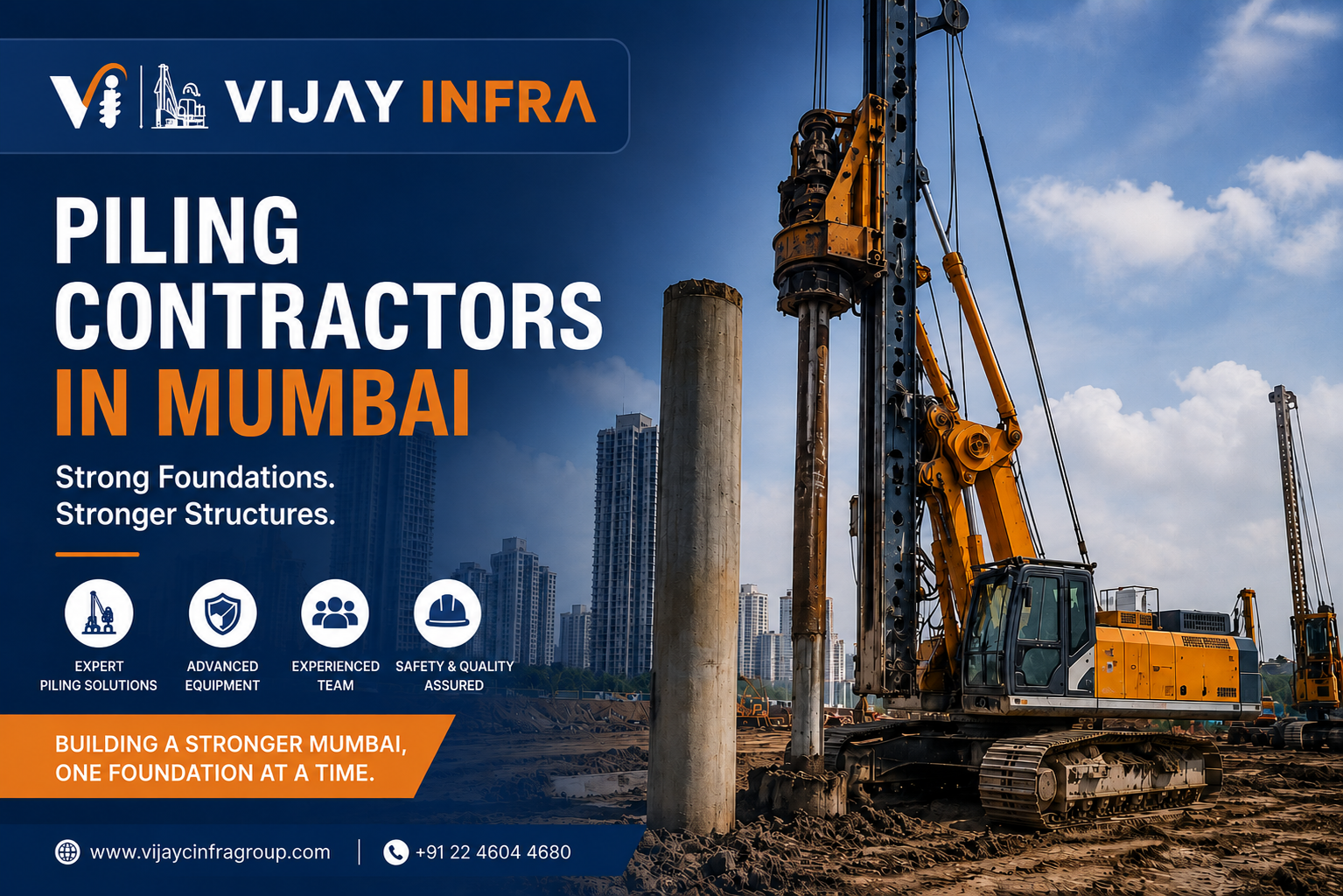
1. Check the Contractor’s Experience and Project History
Experience is an important consideration when evaluating a piling contractor. Every construction site has different ground conditions, access limitations, structural loads and execution requirements. A contractor with relevant project experience is better positioned to understand these challenges and coordinate the work effectively.
Before making a decision, review the contractor’s completed projects, years of experience, technical capabilities and experience with projects similar to yours. Ask for verifiable project references and confirm whether the contractor has handled comparable site conditions and foundation requirements.
Vijay Infra Group has over 22 years of experience in the deep foundation industry. Prospective clients can discuss their site requirements, relevant experience and the technical capabilities needed for their proposed projects.
2. Understand the Piling Methods Available
Different sites require different foundation techniques. The appropriate method depends on factors such as soil conditions, structural loads, groundwater levels, access restrictions and the recommendations of the project’s geotechnical and structural engineers.
When comparing contractors, ask which methods they can execute and why a particular technique is suitable for your site.
Bored Piling
Bored piling involves drilling a borehole, placing a reinforcement cage and casting concrete to form a deep foundation pile. Depending on the equipment and execution method, it can be suitable for urban construction sites where controlling vibration and disturbance to neighboring structures is important.
Ask the contractor about borehole stability, reinforcement placement, concrete installation procedures and the quality-control measures used during execution.
Rotary Piling
Rotary piling uses rotary drilling equipment to create boreholes for foundation piles. The method can be appropriate for high-rise buildings, commercial developments and infrastructure projects, depending on the ground conditions and required pile specifications.
When evaluating a contractor’s rotary piling capabilities, check the available equipment, drilling capacity, access requirements and experience with the ground conditions expected at your site.
Cast-in-Situ Piling
Cast-in-situ piles are formed directly at the construction site by placing concrete into a prepared borehole or casing, as required by the selected construction method. Reinforcement and concrete placement must follow the approved design and project specifications.
Ask how the contractor maintains borehole stability, controls concrete placement and documents the quality of each pile.
Micropiling
Micropiles are small-diameter piles that may be used for underpinning, foundation strengthening, restricted-access locations and projects with limited headroom. Their suitability depends on the required loads, subsurface conditions and engineering design.
If your project involves an existing building or a confined urban site, confirm that the contractor has the equipment and experience needed for the proposed micropiling work.
Casing and Liner Solutions
Temporary or permanent casing may be required to support boreholes in unstable ground conditions and help control soil ingress during pile construction. The appropriate casing method depends on the soil profile, groundwater conditions, pile design and construction procedure.
Ask the contractor how casing will be selected, installed and managed to maintain the required pile quality.
3. Verify Soil Investigation and Site Assessment
Soil investigation provides essential information for foundation planning. Ground conditions can vary significantly across Mumbai and the surrounding region, including areas with soft soil, filled ground, groundwater challenges and hard rock.
Before piling work begins, confirm that the project team has access to appropriate geotechnical investigation data and that the proposed foundation design accounts for the actual site conditions.
Discuss the following points with the contractor and design team:
- Soil profile and bearing characteristics.
- Groundwater levels and their effect on construction.
- Expected pile depth and diameter.
- Structural load requirements.
- Site access, neighboring buildings and underground utilities.
- Investigation and testing requirements specified for the project.
A suitable piling method should be selected on the basis of engineering requirements rather than a standard approach applied to every site.
4. Evaluate Machinery and Technical Capabilities
Piling equipment affects the contractor’s ability to work within the site’s access limitations, ground conditions and project schedule. However, the largest machine is not necessarily the best choice for every construction site.
When reviewing a contractor’s equipment, consider the type of piling rig, drilling capacity, available working headroom, site access, maintenance practices and the suitability of the machinery for the specified pile dimensions.
For projects in congested areas, equipment selection may also influence vibration, noise, movement restrictions and coordination with neighboring properties.
Ask the contractor to explain how the proposed equipment matches your project requirements and what arrangements are needed for mobilization and safe operation.
5. Check Quality Control and Foundation Testing
Foundation quality depends on correct execution and appropriate verification. A completed pile should meet the project’s approved design and applicable technical specifications.
Before awarding the contract, discuss the quality-assurance procedures that will apply throughout the work. Depending on the design and project requirements, these may include:
- Verification of pile location and dimensions.
- Monitoring of drilling depth and ground conditions.
- Inspection of reinforcement cages.
- Control and documentation of concrete placement.
- Pile integrity testing where specified.
- Static or other load testing where required.
- Inspection records and final quality documentation.
Confirm which tests are required, who will conduct them, how the results will be recorded and what acceptance criteria apply. Testing should follow the approved project specifications and relevant engineering standards.
6. Review Safety Procedures and Site Management
Piling operations involve heavy machinery, drilling activities, reinforcement handling, concrete placement and movement around construction sites. Effective site management is essential for protecting workers, nearby properties and other construction activities.
Before appointing a contractor, ask about equipment inspections, operator qualifications, site supervision, emergency procedures, access control and coordination with other contractors.
For urban sites, also discuss traffic and material movement, working-hour restrictions, noise management and measures to reduce disruption to neighboring buildings.
A contractor’s safety procedures should be appropriate to the equipment, site conditions and risks identified for the project.
7. Compare Quotations and Project Timelines
The lowest quotation does not always represent the best overall value. Differences in scope, equipment, pile specifications, testing and site conditions can make two piling quotations difficult to compare directly.
Request a written quotation that clearly identifies:
- The proposed piling method and scope of work.
- Pile dimensions, quantities and applicable specifications.
- Equipment mobilization and demobilization arrangements.
- Reinforcement and concrete responsibilities.
- Testing and quality-control requirements.
- Exclusions, additional charges and site-related assumptions.
- Estimated execution schedule and payment terms.
Compare quotations on a like-for-like basis. Ask contractors to explain any significant differences in price, execution time or scope before making a decision.
8. Check Communication and Project Coordination
Piling work must be coordinated with geotechnical consultants, structural engineers, project managers and other construction teams. Clear communication helps ensure that site information, design revisions and execution requirements are addressed promptly.
During the evaluation process, identify who will manage the project, how progress will be reported and how unexpected ground conditions will be communicated.
A clear reporting process also helps project owners monitor progress against the agreed schedule and identify issues before they affect subsequent construction activities.
9. Assess Experience Across Project Types
A contractor’s experience should be relevant to the type and complexity of the proposed development.
Residential buildings may require careful management of access, noise and nearby structures. Commercial and industrial developments may involve substantial structural loads and demanding execution schedules. Infrastructure projects may require specialized equipment, extensive coordination and project-specific quality controls.
Ask prospective contractors to provide examples of comparable work that they can substantiate. Review the project’s scope, the techniques used and the contractor’s responsibilities rather than relying only on general claims of experience.
Vijay Infra Group works in the deep foundation sector across Mumbai and the surrounding region. Project owners can discuss their proposed development with the company to determine whether its available equipment, technical capabilities and experience are appropriate for the work.
10. Consider the Project Location and Site Conditions
Construction requirements vary across the Mumbai Metropolitan Region. Projects in Mumbai, Navi Mumbai, Thane, Panvel, Kalyan, Dombivli, Vasai, Virar and Bhayander may encounter different soil profiles, access conditions and logistical constraints.
Before selecting a contractor, confirm that the team can mobilize the required equipment to your site and has experience with the specific challenges involved.
The contractor should assess the actual project location, review available soil investigation information and coordinate with the design team before recommending an execution approach.
Why Consider Vijay Infra Group?
Vijay Infra Group has more than 22 years of stated experience in the deep foundation industry and works on piling projects across the Mumbai Metropolitan Region.
When considering Vijay Infra for a project, discuss the following requirements with its team:
- Experience relevant to your project type.
- Available piling equipment and technical capabilities.
- The proposed piling method and execution plan.
- Coordination with geotechnical and structural engineers.
- Quality-control procedures and required foundation testing.
- Site access, mobilization and estimated project timelines.
The suitability of any contractor should ultimately be assessed against the project’s technical requirements, documented experience, safety practices and agreed scope of work.
For more information about pile foundation services in Mumbai, visit the Vijay Infra Group homepage to review the company’s foundation capabilities and service information.
Frequently Asked Questions for Top Piling Contractors in Mumbai
1. How Do I Choose the Right Piling Contractor in Mumbai?
Review the contractor’s relevant project experience, equipment, technical capabilities, safety procedures, quality-control practices and written quotation. Also confirm that the proposed piling method meets your project’s engineering requirements.
2. What Factors Determine the Choice of Piling Method?
The choice depends on soil conditions, groundwater levels, structural loads, pile specifications, site access, nearby structures and the project’s engineering design. The method should be selected after appropriate site investigation and technical assessment.
3. What Is the Difference Between Bored Piling and Rotary Piling?
Bored piling describes a foundation method in which a borehole is formed for the pile. Rotary piling refers to the use of rotary drilling equipment and may be used to construct bored piles. The exact terminology and process depend on the equipment and construction method employed.
4. Why Is Soil Investigation Important Before Piling?
Soil investigation provides information about subsurface conditions, groundwater and soil characteristics. Engineers use this information to assess foundation requirements and develop an appropriate design for the site.
5. What Foundation Tests Should I Ask About?
Ask which pile integrity checks and load tests are required by the approved design and project specifications. The testing programme should identify the methods, acceptance criteria, documentation and responsible parties.
6. Can Micropiles Be Used at Sites With Restricted Access?
Micropiles may be suitable for locations with limited headroom, narrow access or existing structures requiring foundation strengthening. Their use depends on the structural requirements, ground conditions and the equipment available.
7. How Can I Compare Piling Quotations Fairly?
Compare the scope of work, pile dimensions, quantities, materials, equipment, testing, mobilization, exclusions, payment terms and execution schedule. Ensure that each contractor is quoting against the same technical requirements.
8. Does Vijay Infra Group Have Experience in Piling Projects?
Vijay Infra Group states that it has over 22 years of experience in the deep foundation industry. For a proposed project, request relevant project details and confirm that the company’s capabilities match your specific requirements.
9. Which Areas Does Vijay Infra Group Serve?
Vijay Infra Group works across Mumbai and the surrounding Mumbai Metropolitan Region. Confirm service availability, equipment mobilization and site-specific requirements directly with the company for your location.
10. How Can I Contact Vijay Infra Group About a Project?
You can contact Vijay Infra Group to discuss your proposed project, site location, foundation requirements and available technical information. Request a consultation and written quotation after the project scope has been established.
Tips for Choosing Top Piling Contractors in Mumbai
Before making a final decision, verify the contractor’s project history and technical capabilities. Review the proposed foundation method, equipment availability, safety procedures and quality-control plan. Ask for a detailed quotation and clarify testing responsibilities, project timelines and any exclusions.
A careful evaluation helps you compare contractors on the basis of engineering suitability, execution capability and documented project experience rather than price alone.
For additional information about Vijay Infra Group, you can also visit the company’s website.
Conclusion
Selecting a piling contractor in Mumbai requires careful evaluation of technical experience, equipment, site investigation, quality assurance, safety and project coordination. By comparing contractors against clear engineering requirements and reviewing their relevant project history, builders and developers can make a more informed decision.
Vijay Infra Group brings over 22 years of stated experience in the deep foundation industry. If you are evaluating contractors for a residential, commercial, industrial or infrastructure project, discuss your site conditions, proposed foundation requirements and execution expectations with the company before making your decision.
The right contractor should be able to explain the proposed method, identify the work included in the quotation, clarify testing requirements and coordinate effectively with the project’s engineering team. To explore the company’s capabilities, learn more about Vijay Infra Group.